
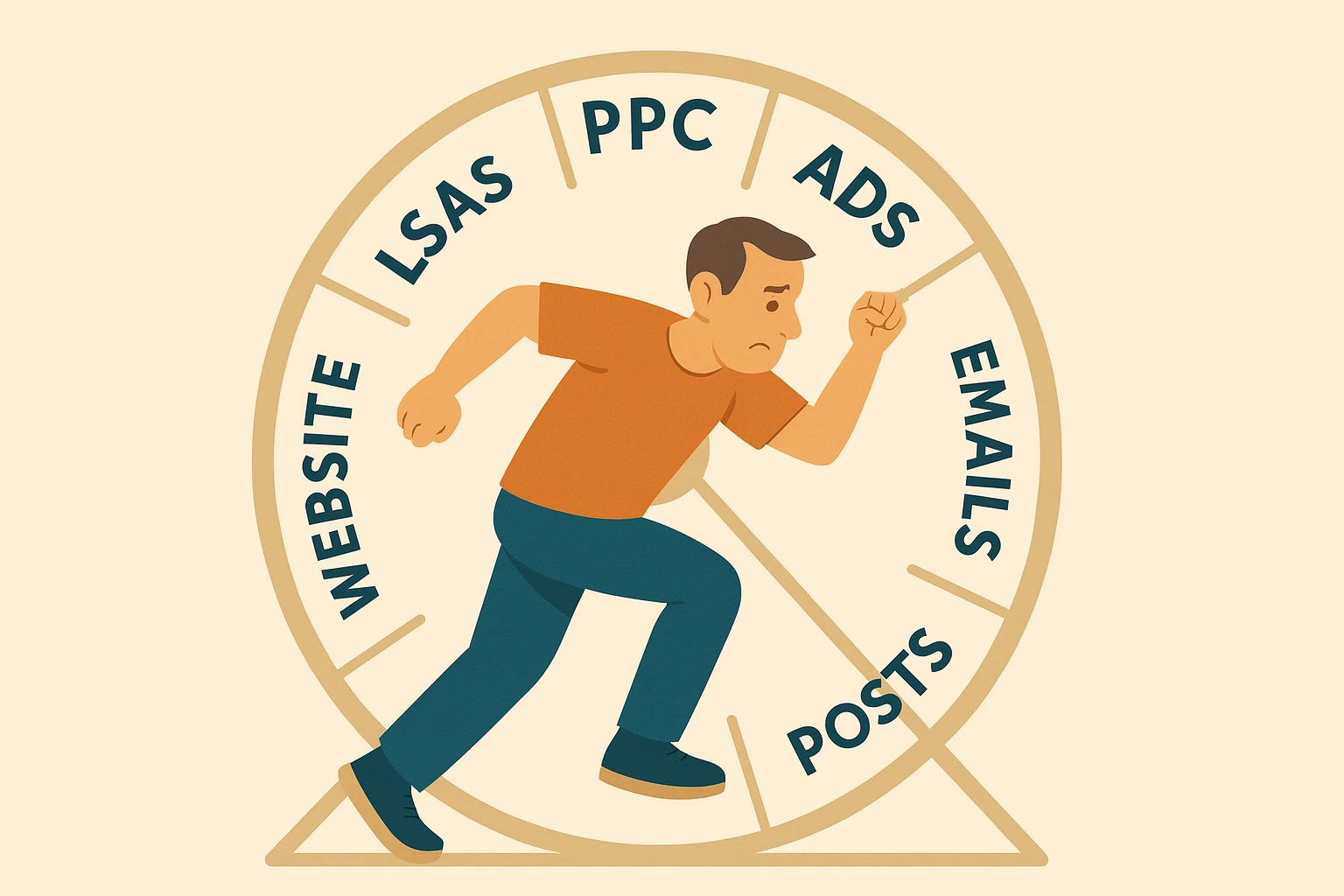
 You’ve hired multiple marketing agencies over the years. Each one promised “more leads,” “better SEO,” and “game-changing campaigns.” Yet you’re still competing on price, still juggling new tactics every quarter, and still wondering why your marketing budget feels like it disappears without producing meaningful growth.
Sound familiar?
After 18 years in the trades industry and conversations with hundreds of frustrated contractors, I’ve learned this truth: most agencies keep home service companies trapped in the wrong game entirely.
The Execution Trap That’s Killing Your Growth
Your agency probably sounds like this: “We’ll get you 50 more leads this month! We’ll post three times a week! We’ll redesign your website with stronger CTAs!”
They’re not wrong about the tactics. They’re just answering the wrong question.
This is the Execution Trap—the cycle where busy activity is mistaken for meaningful progress. Agencies keep you so focused on campaigns, impressions, and lead counts that you never stop to ask the question that actually moves the needle:
Are we positioned to win? Or just positioned to chase?”
Here’s what the Execution Trap looks like in the real world:
- Agency sells a new channel or campaign
- You approve more budget
- Leads go up (temporarily), close rates don’t
- You still can’t raise prices or escape price competition
Busy, but not better. Motion, but not progress.
The Three Pillars Most Agencies Ignore
While agencies obsess over clicks, impressions, and monthly lead reports, they miss the strategic fundamentals that actually drive profitable, sustainable growth.
1. Market Position Before Market Presence
Your agency wants to make you visible. But visibility without positioning is just expensive noise. If you’re not clearly differentiated—meaning prospects instantly know why you’re worth more—then the more visible you become, the more you blend in.
Weak positioning: “Fast, friendly, and fair pricing.”
Strong positioning: “The areas premium boiler and hydronic heating specialists for older homes.”
I’ve seen contractors raise prices by 20–40% while improving their close rates. They didn’t do it with more leads—they did it through stronger positioning. When you own a specific place in the customer’s mind, price becomes a secondary decision.
Ask yourself: If a premium customer compared you to three competitors for 30 seconds, could they instantly identify why you cost more?
2. Systems Before Campaigns
Quick question: What percentage of your marketing budget goes to management fees versus actual media spend? If you don’t know, that’s by design.
The industry standard is 15–25% management fees and 75–85% media spend. But without proper systems, you’re flying blind. Before you run another campaign, you need:
- A clear separation of management fees vs ad spend
- Campaign-level call tracking tied to revenue
- Conversion tracking that includes booked jobs, not just leads
- Customer lifetime value and revenue-per-channel calculations
If your agency can’t show revenue per channel in under 10 minutes, they’re guessing.
3. Revenue Optimization Over Lead Generation
Lead generation companies profit when you stay addicted to new leads. But your existing customer database is worth 5–10x more than cold traffic—and it’s the fastest path to profitable growth.
Integrated multichannel strategies outperform single-channel campaigns by 63%. Yet many agencies push new channels instead of optimizing what’s already working.
Examples of revenue optimization your agency probably isn’t doing:
- A repeat-service and reactivation sequence
- Unsold estimate follow-up systems
- Service-type segmentation for premium offers
- Automated high-value customer nurturing
Your biggest opportunity isn’t more leads, it’s more value per customer.
The 7–10% Rule Nobody Talks About
Top-performing home service companies invest 7–10% of gross revenue into marketing. But here’s the part agencies leave out: the allocation determines your results—not the amount.
Benchmark allocation looks like:
- 40–60% digital channels (Google Ads, LSAs, SEO)
- 15–25% traditional channels (direct mail, outdoor, door hangers)
- 10–20% partnerships and local sponsorships
For a $4M company, that’s a $280K–$400K investment. Misallocating even 20% is a $56K–$80K mistake, and most agencies misallocate far more than that.
Agencies push what they know how to execute. Not what’s strategically best for your market.
Why Phone Calls Still Win (And Why Agencies Avoid Them)
Digital agencies love form fills and chats because they’re easy to track. But phone calls are still the highest-converting lead source in home services. They’re urgent, high-intent, and ready to buy.
Yet many agencies either ignore call tracking or bolt it on as an afterthought, because phone calls reveal the real quality of their leads.
The Strategic Shift That Changes Everything
Stop asking, “How can we get more leads?” and start asking:
“How can we command premium prices while improving our close rate?”
Stop measuring activity. Start measuring:
- Revenue per customer
- Close rates at premium pricing
- Customer lifetime value
- Market share inside your premium segment
Stop hiring vendors who execute tactics. Start working with strategic partners who help build the marketing foundation your company needs to scale.
The Uncomfortable Truth About Your Current Agency
Your agency isn’t necessarily incompetent, they’re just incentivized to keep you tactical. If you suddenly started focusing on positioning, pricing power, and systems, you might need less of what they sell.
And that’s not good for their retention rate.
A Quick Example: How Strategy Beats Tactics
A $6M HVAC company we worked with was stuck at 12% net profit despite strong lead volume. They’d tried several different agencies in four years.
Once we repositioned them as the area’s premium heat-pump and energy-efficient system specialists, and rebuilt their budget allocation, they:
- Raised prices 25%
- Improved close rates
- Reduced marketing channels from 7 to 4
- Grew revenue by $1.8M without increasing lead volume
Not because of more leads. Because of better strategy.
How to Audit Your Agency in 10 Minutes
Ask your agency these questions:
- What makes us worthy of premium pricing, and how does our marketing reflect that?
- Can you show media spend vs management fees for every channel?
- Do you track booked jobs and revenue by campaign?
- How do you optimize our existing customer base?
- What systems have you built to improve close rates and pricing power?
- What’s our actual revenue per channel, not just leads?
If they struggle with these, you don’t have a strategic partner, you have a vendor.
What Actually Works
The path forward is simple, but it requires a different way of thinking:
- Audit your marketing foundation. Positioning, pricing, segmentation, budget allocation, tracking systems.
- Identify what truly differentiates you. Not what you like about your business, what premium customers value enough to pay more for.
- Build your brand around that difference. This is about perception and category ownership, not logos.
- Target premium buyers intentionally. The companies who thrive are the ones who stop trying to serve everyone.
- Measure what matters. Revenue per customer, close rates at premium prices, lifetime value, and share of wallet.
The Choice Is Yours
You can keep chasing leads, switching agencies, lowering prices, and hoping next quarter feels better. That’s the Execution Trap.
Or you can make the strategic shift that top HVAC, plumbing, and electrical companies use to dominate their markets:
Positioning over visibility.
Systems over campaigns.
Revenue optimization over lead generation.
Strategy over tactics.
Your next marketing decision will either perpetuate the cycle, or break it.
Ready to Break the Execution Trap?
If you’re a home service company tired of competing on price and ready to build a marketing system that actually scales, the next step is simple: audit your foundation.