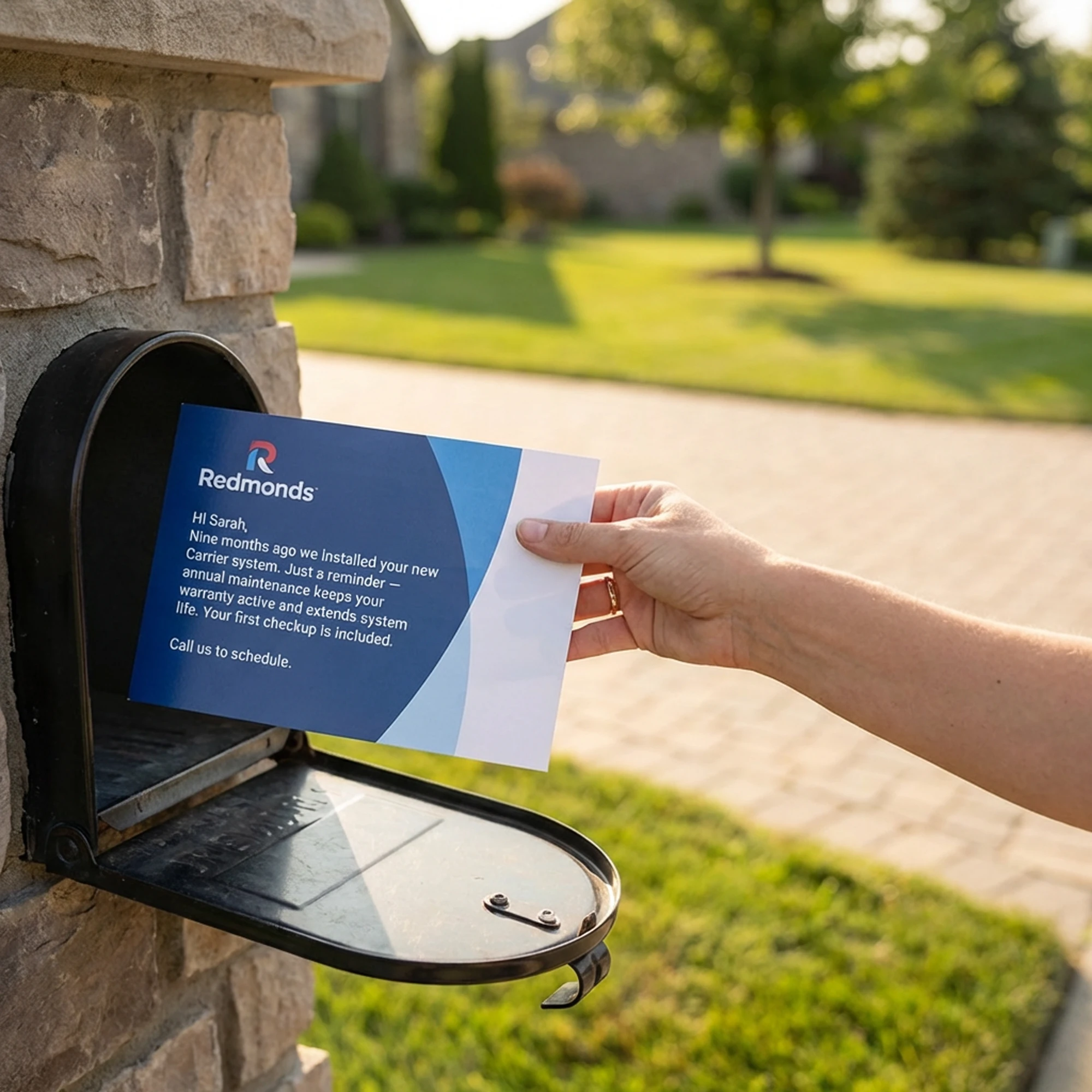
Customer Engagement

The 3x3 Follow-Up System

The 3×3 Follow-Up System for Home Service Companies

The 3x3 Follow-Up System

If you complete 800 jobs this year, you will quietly lose hundreds of those customers forever. Not because they were unhappy. Not because a competitor undercut you. But because you never built a system to stay in front of them.

The average home service company spends $150 to $300 to acquire a new customer. Then they follow up once, maybe twice, and move on. Meanwhile that customer has a house full of aging equipment, deferred maintenance, and future replacement decisions ahead of them.

The 3×3 Follow-Up System is designed to capture that lost revenue. It increases customer lifetime value, strengthens premium positioning, and generates repeat work without adding acquisition cost.

The 3×3 System at a Glance

  • 3 contact types: Completion, Value, Revenue
  • 3 timing windows: 24–72 hours, 3–6 weeks, 90–120 days
  • Primary goal: Increase repeat revenue from existing customers
  • Secondary goal: Strengthen trust and premium positioning

This is not an email trick. It is a structured customer retention strategy for HVAC, plumbing, and electrical companies that want to grow profit without chasing more leads.

Why Customer Follow-Up Systems Fail

Most follow-up fails because it is built around convenience for the company rather than usefulness for the customer.

A generic review request the next day does not build trust. A random check-in email weeks later does not create value. A seasonal promotion sent to everyone regardless of service history feels transactional.

Premium companies operate differently. They build continuity. They communicate with relevance. They demonstrate oversight.

That is what allows them to charge more and close at higher rates. Follow-up is not a retention tactic. It is a positioning strategy.

The Structure: 3 Contact Types × 3 Timing Windows

The system works across three types of outreach deployed across three distinct windows after a service visit. The goal is not to remind customers you exist. The goal is to advance a relationship that already started.

The Three Contact Types

Type 1: The Completion Contact.
Sent within 24–72 hours after service. Its purpose is to confirm satisfaction, surface concerns early, and reinforce the experience. This is not the review request. This is about the customer.

Type 2: The Value Contact.
Delivered 3–6 weeks after service. Educational and advisory. No pitch. No offer. Just relevant information tied to the exact service performed. This is the trust-building layer most companies skip.

Type 3: The Revenue Contact.
Delivered 90–120 days after service. This is where you present a logical next step: maintenance agreement, inspection, seasonal tune-up, or upgrade consultation. By this point, you have earned the right to make an offer.

The Three Timing Windows

Window 1: 24–72 Hours Post-Service
The experience is fresh. The emotional tone is positive. For tickets above $500, this should be a phone call. Lower-ticket jobs can use personalized text or email. Reference the actual job performed.

Window 2: 3–6 Weeks Post-Service
This is where most contractors disappear. Instead, send information that helps the customer protect their investment. HVAC customers may need filter guidance. Plumbing customers may benefit from water quality insights. Electrical customers may appreciate panel load education.

Window 3: 90–120 Days Post-Service
Now present the offer. A maintenance plan feels logical because it connects to previous conversations. A seasonal inspection feels responsible. The offer is positioned as continuity, not sales pressure.

Example: Furnace Repair Follow-Up Sequence

A customer calls in January for a failed ignitor. Your technician completes the repair and notes early heat exchanger wear.

Day 2: Your office calls to confirm the home is warm and references the technician’s note about the heat exchanger. You mention that you will send information explaining what to watch for.

Week 4: You send a brief email explaining heat exchanger function in plain language, signs of wear, and when it becomes a concern. No pitch. Just clarity.

Month 4: You reach out about a fall tune-up and note that the visit would include a follow-up inspection of the previously flagged component. The offer feels responsible and tailored.

In companies that implement this correctly, membership attach rates commonly increase from 15–20 percent into the 30–40 percent range within six months. Not because the offer improved, but because the relationship did.

The Revenue Math Behind Customer Retention

If you complete 800 jobs per year at an average ticket of $400, that is $320,000 in revenue.

If 35 percent of those customers have a follow-on need within 12 months and half of them book a second $300 job because you stayed in contact, that is $42,000 in incremental revenue.

No additional lead cost. No increased ad budget. No price discounting.

This is how high-performing HVAC, plumbing, and electrical companies expand margin. They increase lifetime value instead of increasing acquisition spend.

How to Build This Without Adding Overhead

You do not need a new department. You need structured automation.

  • Segment customers by service type and ticket size.
  • Create 8–10 educational templates tied to your most common jobs.
  • Require phone follow-up for high-ticket work.
  • If available, use your field service management platform to trigger sequences automatically.

Most platforms can segment by job type and automatically enroll customers in the correct sequence.

What begins as a manual process becomes a background system.

Common Follow-Up Mistakes

  • Automating everything with no personalization.
  • Pitching too early before trust is built.
  • Sending identical offers to every customer.
  • Failing to use phone contact for high-value jobs.

Retention systems fail when they feel like marketing. They succeed when they feel like oversight.

Frequently Asked Questions

How often should HVAC companies follow up after service?

At minimum, three times within the first 120 days. A completion contact within 72 hours, an educational value contact at 3–6 weeks, and a revenue-focused offer at 90–120 days.

What is the best way to increase repeat business in plumbing?

Stay relevant to the service performed. Educational follow-up tied to water quality, maintenance intervals, or system longevity significantly increases repeat call rates.

Should review requests come before or after follow-up?

They should follow the completion contact but not replace it. First confirm satisfaction. Then request the review.

Where to Start

Do not build the entire system at once. Choose your most common service type and create the three contacts for that job category. Test it. Refine it. Then expand.

If you are operating between $2M and $10M in annual revenue and do not have a structured post-service revenue system, there is likely a six-figure opportunity gap sitting inside your existing customer base.

This is not about sending more emails. It is about installing revenue continuity.

If you want help building this into your operation without increasing overhead or marketing waste, schedule a 45-minute strategy call.

You already paid to acquire the customer. The 3×3 system ensures you capture the rest of the value.

The 3×3 Follow-Up System for Home Service Companies Read More »
HVAC & Plumbing Membership Programs

HVAC & Plumbing Membership Programs

HVAC & Plumbing Membership Programs

How to Generate Predictable Recurring Revenue

According to ACCA, recurring service agreements now represent over half of HVACR industry revenue, underscoring their importance in stabilizing cash flow and customer relationships.

Yet in spite of this, most HVAC and plumbing companies spend aggressively to acquire customers, then act surprised when they have to acquire the same customer again 18 months later.

You invest $300–$500 to generate a lead. You complete a $2,800 job. Then when that homeowner needs service again, they Google “HVAC repair near me” or “plumber near me” and enter someone else’s funnel.

Membership programs change the economics entirely.

Instead of repeatedly paying to reacquire the same customer, you build a recurring revenue system that increases lifetime value, improves close rates, and reduces customer acquisition costs over time.

In established $2M–$10M home service companies, properly structured membership programs routinely generate $100,000 to $300,000 in annual recurring revenue while reducing paid acquisition dependency by 30–40%.

This isn’t a marketing campaign. It’s revenue infrastructure.


Why HVAC & Plumbing Membership Programs Outperform Traditional Service Agreements

Service agreements have existed in the trades for decades. Most underperform because they are structured as operational products rather than strategic marketing assets.

A true membership program is built around three financial objectives:

  • Recurring revenue generation from monthly or annual fees
  • Increased service frequency from members who call you first
  • Higher replacement close rates due to ongoing trust

The difference is positioning. Service agreements focus on preventing breakdowns. Membership programs focus on preventing customers from ever considering your competitors.

Across mid-sized HVAC and plumbing companies, membership customers typically generate 2–3x more lifetime revenue than transactional customers while exhibiting significantly lower price sensitivity.

“Industry data shows acquiring a new HVAC customer can cost 5× more than retaining an existing one, and improving retention by just 5% can raise profits by up to 95%.”

FieldEdge

The Revenue Architecture of Effective Membership Programs

High-performing membership programs generate revenue from three distinct streams.

1. Membership Fees (Recurring Revenue Base)

For HVAC companies, pricing commonly ranges from $19 to $35 per month. Plumbing programs often range from $15 to $29 per month depending on benefits and market positioning.

At 400 members paying $25 per month, that equals:

  • $10,000 per month in recurring revenue
  • $120,000 annually before additional work

This smooths seasonality and stabilizes cash flow.

2. Increased Service Call Frequency

Members call you first. They do not price shop at the same rate as non-members.

With 400 members generating an average of 2.5 service calls per year, that equals 1,000 service calls captured without paid acquisition.

If your cost per acquired service call is $75–$120, that represents $75,000–$120,000 in avoided marketing spend annually.

3. Higher Replacement Approval Rates

Ongoing maintenance builds trust. Trust increases close rates.

When replacement recommendations occur inside an established relationship, approval rates are often 20–40% higher than cold estimates.

The compounding effect over three years dramatically shifts company economics.


Why Membership Programs Reduce Customer Acquisition Costs

Customer acquisition cost (CAC) reduction happens through three mechanisms:

1. Members Exit the Paid Acquisition Funnel

Members don’t click Google Ads when equipment fails. They call you directly.

Each member who calls you directly represents avoided bidding competition and avoided ad spend.

2. Referral Quality Increases

Member referrals close at significantly higher rates than cold traffic. Referred leads commonly convert at 60–70% compared to 20–30% from paid channels.

3. Revenue Stability Reduces Desperation Bidding

Companies with 30–40% of revenue tied to membership and member-generated work are less reliant on peak-season PPC bidding wars.

This creates a competitive advantage in mid-sized markets where digital ad costs spike during extreme weather events.


How Membership Programs Support Premium Pricing

Membership models reduce price sensitivity because they shift the relationship from transaction to partnership.

Members perceive:

  • Priority access
  • Insider pricing advantages
  • Ongoing protection
  • Reduced risk

When equipment replacement discussions occur inside that relationship, the focus shifts from “price comparison” to “solution trust.”

This is why companies with mature membership bases often sustain 20–40% price premiums while maintaining strong close rates.


Structural Elements That Drive Enrollment

Enrollment success depends more on structure than marketing budget.

Keep Benefits Simple

Three core benefits outperform twelve minor perks.

For HVAC:

  • Priority scheduling during peak season
  • Annual precision tune-ups
  • Member-only repair discounts

For Plumbing:

  • Annual plumbing inspection
  • Drain maintenance credit
  • Emergency response priority

Lead With Monthly Billing

$24.95 monthly converts significantly higher than $299 annual, even when annual represents better value.

Technician Enrollment Drives Growth

In-home enrollment typically accounts for 60–70% of total memberships.

Companies that train every technician to present membership after every service call enroll 3–5x more members than companies that rely solely on email or website promotion.


Financial Modeling: A Three-Year Projection

Year One

  • 120–200 members
  • $30,000–$50,000 ARR

Year Two

  • 280–360 members
  • $70,000–$95,000 ARR
  • Increased member service revenue

Year Three

  • 480–620 members
  • $125,000–$165,000 ARR
  • Total revenue impact exceeding $300,000

These projections assume 80–85% annual retention and consistent technician enrollment systems.


Retention Systems That Protect Lifetime Value

Retention determines profitability.

Programs with 85% retention behave fundamentally differently than programs with 60% retention.

Automated Maintenance Scheduling

Members should never have to remember to book their tune-up.

Ongoing Communication

Monthly or quarterly member communication increases renewal rates by keeping value visible.

Automatic Renewal Billing

Credit card auto-renewal produces significantly higher retention than invoice-based renewal systems.


Common Mistakes That Sabotage Membership Growth

  • Overcomplicating tiers and pricing
  • Failing to train technicians on enrollment
  • Underpricing to “get more members”
  • Tracking only membership fee revenue instead of total member revenue
  • Ignoring retention metrics

Membership growth is not a marketing trick. It is an operational discipline.


Frequently Asked Questions About HVAC & Plumbing Membership Programs

How many members does an HVAC company need to see meaningful revenue?

Most companies begin seeing material financial impact around 250–300 active members. Significant compounding effects occur beyond 400 members.

What is the average HVAC membership retention rate?

Well-structured programs typically achieve 80–90% annual retention when maintenance scheduling and billing systems are automated.

Should HVAC memberships be monthly or annual?

Monthly billing converts at significantly higher rates. Many companies offer both but lead with monthly enrollment.

Do plumbing companies benefit from membership programs?

Yes. Plumbing memberships drive preventative visits, emergency call preference, and increased water heater replacement close rates.

Are membership programs effective in smaller markets?

In smaller to mid-sized markets, membership programs often perform better because brand familiarity and relationship equity carry greater weight.


Your First 90 Days

Days 1–14: Define three core benefits, set pricing between $19.95–$29.95 monthly, select billing software.

Days 15–30: Train technicians, establish enrollment incentives, role-play objection handling.

Days 30–60: Launch to existing customer database via email and direct mail.

Days 60–90: Optimize technician enrollment and monitor retention metrics.


Final Perspective

Membership programs represent one of the most reliable paths to predictable recurring revenue in HVAC and plumbing businesses.

They increase lifetime value, reduce acquisition dependency, and make premium pricing easier to sustain.

The model works. The compounding economics are well established.

The real question is whether you are willing to build the systems required to reach critical mass — and maintain them for 18–24 months until the financial advantages become undeniable.

For companies willing to execute consistently, 400+ members generating $150,000+ in predictable annual revenue is not aggressive. It is achievable.

The revenue is already inside your customer base. Membership simply captures it systematically.

HVAC & Plumbing Membership Programs Read More »

Improving Lifetime Customer Value In Home Services

From One-Time Repair to Lifetime Customer

Improving Lifetime Customer Value In Home Services

A post-service follow-up sequence that turns every completed job into long-term revenue.

Your technician just finished a $350 garbage disposal replacement. The homeowner’s happy. The invoice is paid. Your tech moves on to the next call… and that customer quietly disappears into your database.

Then their water heater fails in three years, and they Google “plumber near me” instead of calling you, because they forgot your name. Not because you did bad work, but because you never gave them a reason to remember you.

This is one of the most expensive failures in home services: customers you already served, already impressed, already paid to acquire—who drift away because there’s no system for what happens after the truck leaves the driveway.

And the stakes are high. It’s estimated the average customer lifetime value (CLV) for HVAC is about $47,200,

That means a $350 repair isn’t a $350 transaction. It’s the first page of a relationship that can generate tens of thousands in future revenue, if you have a system to keep the relationship alive between service events.


What You’ll Learn


Why the Post-Service Window Is the Most Valuable Moment You’re Ignoring

Right after a completed service call, homeowners are in the highest-trust, highest-satisfaction state they’ll ever be in with your company.

They watched your technician work. They felt the relief of a solved problem. They experienced your professionalism and pricing. If the experience was good, you’ve earned trust you can’t replicate with ads.

But that trust decays quickly. Within days, the emotional residue fades. Within weeks, the job becomes “fine.” Months later, they remember a truck was in the driveway at some point.

This isn’t a loyalty problem. It’s a communication system problem. Most homeowners don’t “leave” you, they simply stop thinking about you.

So the goal of post-service marketing isn’t to “sell.” It’s to stay relevant, and to do it with a timed sequence that feels helpful, specific, and connected to what you just did in their home.


The Anatomy of a Post-Service Marketing Sequence

A post-service sequence isn’t a generic newsletter or a monthly blast. It’s a triggered series of messages that begins when a job is completed and continues for years, each touchpoint serving a specific purpose at a specific time.

Think in five time horizons:

  1. First 48 hours: Cement the experience
    • Send a genuine thank-you + short summary of what was done.
    • Confirm warranty/guarantee details.
    • Then (secondarily) request a review.

    Key rule: lead with appreciation and clarity, not “Rate us on Google.” The sequence should feel like professional follow-through, not a reputation grab.

  2. Days 3–7: Service-specific education
    • Water heater: temperature setting guidance + what the warranty covers.
    • Drain cleaning: what causes repeat backups + warning signs.
    • Electrical repair: safe load/usage + surge protection considerations.
    • HVAC repair: what seasonal maintenance extends life.

    This isn’t content marketing. It’s proof you’re a trusted advisor, built on the job you just completed.

  3. Weeks 2–4: Soft introduction to maintenance
    • Not a hard sell—an “FYI” tied to the service they just received.
    • Show what’s included and why it prevents future issues.
    • Make enrollment feel like a logical next step, not an upsell.

    Why this timing matters: it separates the maintenance decision from the repair bill moment, so the customer evaluates it on its own merits.

  4. Months 2–6: Seasonal relevance + gentle re-engagement
    • Use service history to stay specific (not generic “Fall is here” blasts).
    • Example: If you cleared a main drain in summer, send a cold-weather reminder in fall in freeze-prone climates.
    • Example: If you installed an HVAC system in spring, follow up before winter with a targeted check-in.

    Specificity is what separates emails that get opened from emails that get deleted.

  5. Ongoing annual cadence: Protect the long-term relationship
    • Anniversary reminders tied to the install/service date.
    • Maintenance reminders.
    • Equipment-age milestones that naturally lead to replacement conversations.
    • Safety checks and efficiency assessments as equipment ages.

    This is where the real CLV shows up—year-over-year contact for the next 10–20 years.


Which Channels to Use (and When)

Most contractors default to email only. The best systems blend channels—because homeowners don’t all pay attention in the same place.

  • 48 hours: Email (summary + warranty) + SMS (short thank-you + link to summary/review)
  • 3–7 days: Email education (service-specific)
  • 2–4 weeks: Email maintenance intro + optional SMS nudge (for high-value categories)
  • 2–6 months: Email seasonal check-ins + SMS for appointments (“Want us to take a look before winter?”)
  • Annual cadence: Email + (optional) postcard for major equipment categories and long gaps between service events

Direct mail is especially effective for “long gap” services (replacement cycles, annual checkups) because it stays visible in the home longer than an email.


Build the System From Your Existing FSM Data (In 7 Steps)

You already have the raw material: completed job data, dates, service types, equipment notes, and customer contacts inside your field service management platform.

  1. Choose your first category: start with installs/replacements (highest lifetime value potential).
  2. Define 4–6 service buckets: installs, major repairs, maintenance, drain/sewer, diagnostics/minor repairs, etc.
  3. Map the five horizons: decide the purpose of each touchpoint per bucket.
  4. Write modular templates: build 2–3 message variants per touchpoint (keeps it from feeling automated).
  5. Set trigger logic: “job completed” + “service type” + (optional) “equipment tag.”
  6. Pick your channel mix: email + SMS (and postcard where appropriate).
  7. Measure and refine monthly: reviews, maintenance enrollments, callback rate, booked jobs from follow-ups.

Tip: if your system supports it, tag the job at closeout (install / repair / drain / maintenance) so automation stays clean.


The Maintenance Agreement Bridge

Inside the sequence, the most important milestone is converting a one-time customer into a maintenance agreement customer—because memberships create recurring revenue, guaranteed annual touchpoints, and first call rights on future work.

There’s strong evidence that maintenance agreements create significant “pull-through” revenue. Companies report pull-through work generating anywhere from $1 to $3+ in additional revenue for every $1 of maintenance agreements in place.

Industry program data also supports the idea that service agreement customers contribute materially to total revenue; for example, FieldEdge notes preventive maintenance contracts capturing a meaningful share of HVAC revenue in recent reporting.

Make your maintenance offer feel like protection + priority, not a subscription.

Example positioning block (use your actual details):

  • What’s included: annual system check, priority scheduling, safety inspection, and member savings on repairs
  • Why it matters: extends equipment life, reduces breakdown risk, catches issues early
  • Who it’s for: homeowners who want fewer surprises and faster help when something goes wrong

Why Retention Pays

Bain & Company’s retention research (often attributed to Frederick Reichheld) is widely cited for the idea that increasing retention by 5% can increase profits by 25% to 95%.

The same Bain retention overview also reinforces a core reality: acquiring new customers is far more expensive than keeping existing ones.

And there’s still massive headroom: Workyard cites that only about 30% of homeowners schedule preventative maintenance.


What the Numbers Can Look Like

  • HVAC CLV: ~$47,200 estimate (FirstPageSage; also cited by EnerTech USA).
  • Retention impact: +5% retention can raise profits by 25% to 95% (Bain).
  • Service life: many HVAC components commonly land in the ~15–20 year range with proper maintenance ( HVAC.com).
  • Replacement cost range: replacement commonly falls into the ~$7,500–$15,000 range depending on system and scope (R10; HVAC.com provides additional context/ranges).

Estimated example:

Imagine a $3M home services company completing ~3,000 calls/year (an illustrative mix that implies roughly a $1,000 blended average ticket—your numbers may vary). If a post-service sequence improves 24-month “return customer” behavior from 20% to 30% (an internal/industry-informed estimate), that’s 300 additional returning customers.

If those 300 customers average $1,200 in annual follow-on revenue through maintenance plus additional service, that’s ~$360,000 in annual revenue created from customers you already served.

Now layer in replacements. If your system helps you retain even a modest number of additional replacements that would have gone elsewhere—using the cited replacement cost ranges above—the upside grows quickly.


Why Most Companies Never Build This

  • The revenue is “invisible”: when a customer calls 14 months later, it looks like the phone “just rang.”
  • It requires upfront work: the payoff compounds over months and years, not by Friday.
  • Most vendors don’t sell it: many marketing services are built around lead gen, not retention systems that reduce dependence on buying leads.

Start Simple: Launch One Sequence in 7 Days

Don’t build everything at once. Start with installs/replacements and ship a five-touch sequence:

  • 48 hours: thank-you + work summary + warranty info (+ review request secondary)
  • 1 week: education about the installed system
  • 3 weeks: soft maintenance plan introduction
  • 3 months: seasonal check-in
  • 12 months: anniversary reminder + inspection/renewal offer

Track three things for 90 days: engagement (opens/clicks), maintenance enrollments from the sequence, and callback rate compared to your baseline.


The Compounding Effect

When post-service follow-up becomes part of your operating system, every service call stops being a transaction and starts being an investment. Every completed job adds future revenue potential to a system that runs automatically—without relying on new lead spend to keep the phone ringing.

The $47,000+ lifetime value number isn’t magic. It’s what happens when you build the retention machine that captures it, one completed job at a time.

Next step: choose one category, write the five messages, and launch the first sequence. Then expand one service bucket at a time.


FAQ

What is a post-service follow-up sequence?

A triggered set of messages that starts immediately after a job is completed and continues over time—designed to keep you top-of-mind, educate the customer, and convert one-time calls into repeat revenue.

How long should the sequence run?

Start with 12 months. The real payoff comes from an annual cadence that continues for years (anniversary reminders, seasonal check-ins, and maintenance prompts).

What should the first message say?

Thank them, summarize what was done, clarify any warranty/guarantee details, and provide a single “if anything feels off, reply/call us” instruction. Then (optionally) include a review link as a secondary ask.

How do you segment customers?

By service type (install vs. repair vs. maintenance vs. drain/sewer, etc.), and when possible by equipment tag and service date. One-size-fits-all sequences lose specificity and performance.

:contentReference[oaicite:0]{index=0}

From One-Time Repair to Lifetime Customer Read More »

Email Marketing Strategies for Home Service Contractors

Email Marketing Strategies for Home Service Contractors

Email Marketing Strategies for Home Service Contractors

The $50,000 Hiding in Your Customer Database

How many customers are in your field service management software right now? Not leads. Not estimates. Actual customers—people who have paid you money for work in the past.

For most established HVAC, plumbing, and electrical companies, that number falls somewhere between 3,000 and 15,000 households. Every one of those households already knows your company, already trusted you enough to let a technician into their home, and already owns systems that will eventually need service, repair, or replacement.

Now ask yourself: when was the last time you systematically communicated with all of them?

If the answer is “never” or “we send a Christmas card,” you’re sitting on one of the most valuable and underutilized assets in your business. That customer list isn’t just a record of past transactions. It’s a database of future revenue waiting to be activated.

This applies specifically to established home service companies with thousands of past customers. If you already have steady demand and want to grow more efficiently, this is where leverage lives.

The math is straightforward. If you have 5,000 customers and generate just one additional service call from 2% of them over the next year—100 customers—at an average ticket of $500, that’s $50,000 in revenue. From an email that costs essentially nothing to send. No ad spend. No lead generation fees. No competing with every other contractor bidding on the same Google keywords.

That $50,000 isn’t hypothetical. It’s conservative. Companies that build systematic email programs around their existing customer base routinely generate far more, not just from service calls, but from maintenance agreements, equipment replacements, and referrals that come from staying top of mind.

Why Most Service Companies Ignore Their Best Asset

If email marketing to existing customers is so valuable, why don’t more contractors do it? There are a few consistent reasons.

First, it doesn’t feel urgent. New leads demand immediate attention. The phone rings, a call gets dispatched, and revenue follows. Email to past customers doesn’t ring any bells. There’s no forcing function, so it gets pushed to “someday,” indefinitely.

Second, most owners think of marketing as lead generation. Agencies and vendors train contractors to focus on acquiring new customers, not nurturing existing ones. The conversation revolves around cost per lead instead of lifetime customer value. That framing is backwards, but it’s common.

Third, the technical setup feels complicated. Customer data lives in ServiceTitan, Jobber, or Housecall Pro. Getting it into an email platform feels like one more thing on an already long list.

Fourth, many owners don’t know what to say. They’re not writers. The idea of producing content regularly feels overwhelming, so nothing gets sent.

Every one of these obstacles is solvable. And solving them unlocks a revenue stream that keeps producing year after year with minimal ongoing investment.

The Three Email Campaigns Every Service Company Needs

You don’t need a sophisticated content operation to extract value from your customer list. You need three foundational campaigns that address three distinct opportunities: reactivation, seasonal demand, and relationship maintenance.

Each campaign serves a different purpose, but together they turn your customer database into a predictable revenue asset.

Reactivation Campaigns

The reactivation campaign targets customers who haven’t called in a defined period, typically 12 to 18 months. These are people who used your services, likely had a good experience, and then disappeared—not because they were unhappy, but because life got busy or another company happened to reach them first.

The message is simple: “It’s been a while since we’ve helped you. We’d love to take care of your heating, cooling, plumbing, or electrical needs.” Add a reason to act now—a seasonal reminder, a free inspection, or a modest incentive.

Typical performance is remarkably consistent. Expect 15–25% open rates and 1–3% of recipients booking a call within 30 days. On a list of 1,000 dormant customers, that’s 10–30 service calls from a single email. At a $400 average ticket, that’s $4,000–$12,000 in revenue.

Sent quarterly, reactivation campaigns alone can produce $16,000–$48,000 annually.

Seasonal Campaigns

Seasonal campaigns align with natural demand patterns. Before summer, you email about AC tune-ups. Before winter, heating inspections. Before holidays, electrical safety or plumbing stress from houseguests.

These campaigns work because customers are already thinking about the problem. You’re not creating demand. You’re capturing it before someone else does.

Seasonal campaigns also create legitimate urgency. “Schedule before our busy season” isn’t pressure—it’s reality. Customers understand that service companies book up when temperatures swing.

Relationship Campaigns

The relationship campaign is your ongoing newsletter, sent monthly or quarterly. It’s not about immediate response. It’s about staying familiar.

Content can include maintenance tips, energy-saving advice, rebate reminders, or light company updates. The goal is simple: when a customer needs service, your name comes to mind first.

This is also where referrals come from. People recommend companies they hear from regularly, not ones they forgot existed.

What to Actually Say

The content doesn’t need to be elaborate. Simple, clear, and human works best.

For reactivation emails, acknowledge the relationship. “It’s been a while since we’ve helped you.” Then give a reason to respond and a clear call to action. Three to four short paragraphs is enough.

For seasonal campaigns, lead with the problem you solve. Explain what can go wrong if it’s ignored, then position your service as the easy solution.

For newsletters, lead with value. Share something useful before you ask for anything. Helpful emails get read. Promotional-only emails get ignored.

Across all campaigns, write the way you talk to customers. Use “you” and “we.” If it sounds like it came from a marketing department, it will be treated like marketing.

Segmentation: The Multiplier

These campaigns work even if you send them to your entire list. They work dramatically better when you segment.

If you do nothing else, segment by service type and last service date.

HVAC customers should get HVAC emails. Plumbing customers should get plumbing content. Someone who’s never used your electrical services doesn’t need an electrical panel upgrade promotion—but they might respond well to an introduction to that division.

Service history adds another layer. Customers with older equipment are candidates for replacement messaging. Customers who declined a repair may need a follow-up months later. Customers with recent major work may be ideal maintenance agreement prospects.

Your FSM software already contains this data. The difference is whether you’re using it.

The Technical Setup

Getting customer data from your FSM into an email platform is simpler than most people expect.

Most systems can export customer data as a CSV file. Platforms like Mailchimp, Constant Contact, ActiveCampaign, or HubSpot can import that data and segment based on the fields you provide.

The manual approach, exporting and uploading once a month, works fine to start. As you scale, tools like Zapier or more advanced setups using Directus or n8n can automate the process.

Don’t let automation be the barrier. A manual email program generates infinitely more revenue than a perfect system that never gets built.

Measuring What Matters

Ignore vanity metrics and focus on signals that drive decisions.

Open rate tells you if subject lines and deliverability are working. 20–30% is healthy. Below 15% signals a problem. Above 35% is excellent.

Click rate tells you if your message and call to action resonate. Healthy click rates fall between 2–5%.

The metric that actually matters is revenue. Track which customers book calls after campaigns. Directional attribution is enough. Over time, patterns become obvious.

The Compounding Effect

The real power of email marketing isn’t any single campaign. It’s consistency.

Year one produces incremental revenue. Year two produces recurring customers, maintenance agreements, and referrals. Year three produces leverage, the same effort generates more results because the relationship asset has matured.

This is why sophisticated operators invest in customer communication. It compounds.

Getting Started This Week

If you’re not emailing your customer list today, start small.

Export customers from the past three years. Clean the list. Choose a platform. Send one reactivation email to customers who haven’t called in 12+ months.

Track calls for the next two weeks. Calculate the revenue. Then decide whether to do it again.

Most owners become believers after one send. The revenue is too obvious to ignore.

Your customer database is an asset. Start treating it like one.

Email Marketing Strategies for Home Service Contractors Read More »

Premium Marketing Strategy

How to Position Your Company as the Premium Choice

Premium Marketing Strategy

Premium Service Marketing Strategy

In competitive markets, being “affordable” isn’t enough. The companies that thrive are the ones that position themselves as the premium choice, winning higher-margin jobs without competing on price.

Here’s a scenario that plays out every day: your sales team presents a proposal. The prospect says, “Your price is higher than the other quotes I got.” Your rep scrambles to justify the difference, talks about quality and experience, maybe offers a discount. The deal either drags on or goes to the cheaper competitor.

Now imagine this instead: the prospect already knows you’re the premium option before they even call. They expect to pay more. When they hear your price, they nod and ask, “What’s the timeline to get started?” The difference isn’t what you say during the sales conversation, it’s what you’ve already built before it begins.

This is the power of premium positioning. It’s not marketing fluff; it’s a strategic framework that makes selling easier from first contact to final signature.

Why Premium Positioning Helps You Sell More (and Faster)

Many business owners fear that positioning themselves as premium will shrink their market. They worry about “pricing themselves out.” The opposite is true when you do it right.

Price objections decrease. When prospects already see you as the premium option, they’re mentally prepared for higher pricing. The conversation shifts from “why so expensive?” to “is this the right solution for me?”

Sales cycles shorten. Budget shoppers self-select out early. Qualified buyers move faster. Studies show companies with clear premium positioning close deals up to 50% faster than competitors without it.

Conversion rates improve. Clarity beats volume. When your message is focused and specific, the right customers resonate and convert at higher rates than when you try to appeal to everyone.

Your sales team gains confidence. A clear, proven value story replaces price apologies. Your team can own the conversation rather than defend it.

3 Steps to Build a Premium Brand That Justifies Higher Prices

1. Identify Your Differentiating Value

“We provide quality service” isn’t differentiation. Everyone says that. Your differentiating value must be:

  • Specific: Instead of “fast service,” say “guaranteed same-day response with a two-hour arrival window.”
  • Provable: Back up claims with data, certifications, warranties, or guarantees.
  • Valuable to your target customer: Differentiate on what matters to them, not to you. A homeowner might care more about warranty length or communication than the origin of your parts.
Pro Tip: Ask, “What do we do that competitors can’t or won’t?” The answer often reveals your real edge.

2. Build Your Brand Around That Difference

Once you know what makes you different, every marketing touchpoint should reinforce it. This is where brand marketing becomes a sales tool.

  • Your website should show, not tell. Use before-and-after photos, process visuals, and guarantees that support your positioning.
  • Your Google Business Profile reviews should highlight specifics (“They used thermal imaging to find a leak other plumbers missed”).
  • Your sales materials should make price comparison irrelevant by proving why your process or results are unique.

Even your hold music, email signature, and proposal templates should align with your premium brand. Every detail builds the perception that “these people are different.”

3. Target and Message to Premium Buyers

Not everyone is your customer. Premium positioning means focusing on the right ones.

  • Geographic targeting: Focus ad spend on neighborhoods where premium buyers live. A $5,000 HVAC replacement means different things in different zip codes.
  • Message matching: Use ad copy that pre-qualifies. Instead of “HVAC repair, call now,” say “Premium HVAC solutions for homeowners who value comfort and reliability.”
  • Expert content: Premium buyers research before buying. Publish in-depth articles, case studies, and FAQs that show expertise and justify your value.

How to Respond to Price Objections with Confidence

Even with great positioning, prospects may question price. The conversation changes depending on your positioning.

Before:
“Your price is too high.”
“We use quality materials and experienced technicians…”
“The other guy said the same thing and he’s $2,000 less.”

After:
“Your price is higher than I expected.”
“That’s right. We’re typically 20–30% higher than basic providers because we include [specific differentiator]. The question isn’t whether we’re cheapest, it’s whether you want [outcome your difference provides]. If price is the top concern, we can recommend other good companies who may be a better fit.”

This approach reinforces your positioning rather than defending it. It gives the prospect permission to choose differently, which often increases respect and conversion.

Real-World Example: How One HVAC Company Used Positioning to Increase Close Rates

Company A markets itself as “honest, reliable, affordable.” They compete on price, offer frequent discounts, and emphasize longevity. Their average job value is $6,500, and they close about 40% of estimates.

Company B brands itself as “The Indoor Air Quality Specialists.” Every message focuses on health, comfort, and advanced diagnostics. They show thermal imaging reports, air quality test results, and explain their assessment process. Their average job is $8,500, and they close 58% of estimates.

Company B isn’t necessarily better at HVAC installation. They’re positioned better. They’ve built a story that matters to health-conscious homeowners, and their sales team confidently reinforces it.

Step-by-Step Premium Positioning Plan (12-Week Guide)

Weeks 1–2: Define Your Differentiation

  • Survey your best customers; why did they choose you?
  • Interview your sales team; what makes deals easy or hard?
  • Audit competitors; what do they all claim? Say something different.
  • List 3–5 specific, provable, valuable differentiators.

Weeks 3–4: Align Your Messaging

  • Rewrite your website homepage around your key differentiator.
  • Update your Google Business Profile description.
  • Create ad copy that pre-qualifies premium buyers.
  • Develop sales scripts that confidently explain your value.

Weeks 5–8: Build Supporting Evidence

  • Gather case studies and testimonials mentioning your differentiator.
  • Create videos or photo stories showing your process and results.
  • Add guarantee or warranty language that reinforces your positioning.

Weeks 9–12: Train Your Team

  • Role-play price objection responses.
  • Practice explaining your difference in 30 seconds or less.
  • Design proposal templates that highlight premium value.
  • Establish when to walk away from price-only prospects.

The Bottom Line

Premium positioning isn’t about charging more for the same thing. It’s about clearly communicating genuine value to the customers who care most. It makes it easy for the right people to choose you and for the wrong ones to self-select out.

When done well, premium positioning transforms your business from “one of several options” into “the obvious choice.” It raises margins, improves close rates, and builds a sustainable brand that doesn’t rely on discounting.

The question isn’t whether you can afford to position as premium. It’s whether you can afford not to.


Ready to reposition your brand as the premium choice?
Let’s talk about a strategy that fits your market and team. Schedule a consultation.

How to Position Your Company as the Premium Choice Read More »

Wordpress Social Share Plugin powered by Ultimatelysocial
Scroll to Top