A post-service follow-up sequence that turns every completed job into long-term revenue.
Your technician just finished a $350 garbage disposal replacement. The homeowner’s happy. The invoice is paid. Your tech moves on to the next call… and that customer quietly disappears into your database.
Then their water heater fails in three years, and they Google “plumber near me” instead of calling you, because they forgot your name. Not because you did bad work, but because you never gave them a reason to remember you.
This is one of the most expensive failures in home services: customers you already served, already impressed, already paid to acquire—who drift away because there’s no system for what happens after the truck leaves the driveway.
And the stakes are high. It’s estimated the average customer lifetime value (CLV) for HVAC is about $47,200,
That means a $350 repair isn’t a $350 transaction. It’s the first page of a relationship that can generate tens of thousands in future revenue, if you have a system to keep the relationship alive between service events.
What You’ll Learn
- Why the 48–72 hour window is the most valuable moment you’re ignoring
- The five-horizon post-service sequence
- Which channels to use (email, SMS, direct mail) and when
- How to build it from your existing FSM data in 7 steps
- What the numbers can look like (and what’s an estimate vs. sourced)
- FAQ
Why the Post-Service Window Is the Most Valuable Moment You’re Ignoring
Right after a completed service call, homeowners are in the highest-trust, highest-satisfaction state they’ll ever be in with your company.
They watched your technician work. They felt the relief of a solved problem. They experienced your professionalism and pricing. If the experience was good, you’ve earned trust you can’t replicate with ads.
But that trust decays quickly. Within days, the emotional residue fades. Within weeks, the job becomes “fine.” Months later, they remember a truck was in the driveway at some point.
This isn’t a loyalty problem. It’s a communication system problem. Most homeowners don’t “leave” you, they simply stop thinking about you.
So the goal of post-service marketing isn’t to “sell.” It’s to stay relevant, and to do it with a timed sequence that feels helpful, specific, and connected to what you just did in their home.
The Anatomy of a Post-Service Marketing Sequence
A post-service sequence isn’t a generic newsletter or a monthly blast. It’s a triggered series of messages that begins when a job is completed and continues for years, each touchpoint serving a specific purpose at a specific time.
Think in five time horizons:
- First 48 hours: Cement the experience
- Send a genuine thank-you + short summary of what was done.
- Confirm warranty/guarantee details.
- Then (secondarily) request a review.
Key rule: lead with appreciation and clarity, not “Rate us on Google.” The sequence should feel like professional follow-through, not a reputation grab.
- Days 3–7: Service-specific education
- Water heater: temperature setting guidance + what the warranty covers.
- Drain cleaning: what causes repeat backups + warning signs.
- Electrical repair: safe load/usage + surge protection considerations.
- HVAC repair: what seasonal maintenance extends life.
This isn’t content marketing. It’s proof you’re a trusted advisor, built on the job you just completed.
- Weeks 2–4: Soft introduction to maintenance
- Not a hard sell—an “FYI” tied to the service they just received.
- Show what’s included and why it prevents future issues.
- Make enrollment feel like a logical next step, not an upsell.
Why this timing matters: it separates the maintenance decision from the repair bill moment, so the customer evaluates it on its own merits.
- Months 2–6: Seasonal relevance + gentle re-engagement
- Use service history to stay specific (not generic “Fall is here” blasts).
- Example: If you cleared a main drain in summer, send a cold-weather reminder in fall in freeze-prone climates.
- Example: If you installed an HVAC system in spring, follow up before winter with a targeted check-in.
Specificity is what separates emails that get opened from emails that get deleted.
- Ongoing annual cadence: Protect the long-term relationship
- Anniversary reminders tied to the install/service date.
- Maintenance reminders.
- Equipment-age milestones that naturally lead to replacement conversations.
- Safety checks and efficiency assessments as equipment ages.
This is where the real CLV shows up—year-over-year contact for the next 10–20 years.
Which Channels to Use (and When)
Most contractors default to email only. The best systems blend channels—because homeowners don’t all pay attention in the same place.
- 48 hours: Email (summary + warranty) + SMS (short thank-you + link to summary/review)
- 3–7 days: Email education (service-specific)
- 2–4 weeks: Email maintenance intro + optional SMS nudge (for high-value categories)
- 2–6 months: Email seasonal check-ins + SMS for appointments (“Want us to take a look before winter?”)
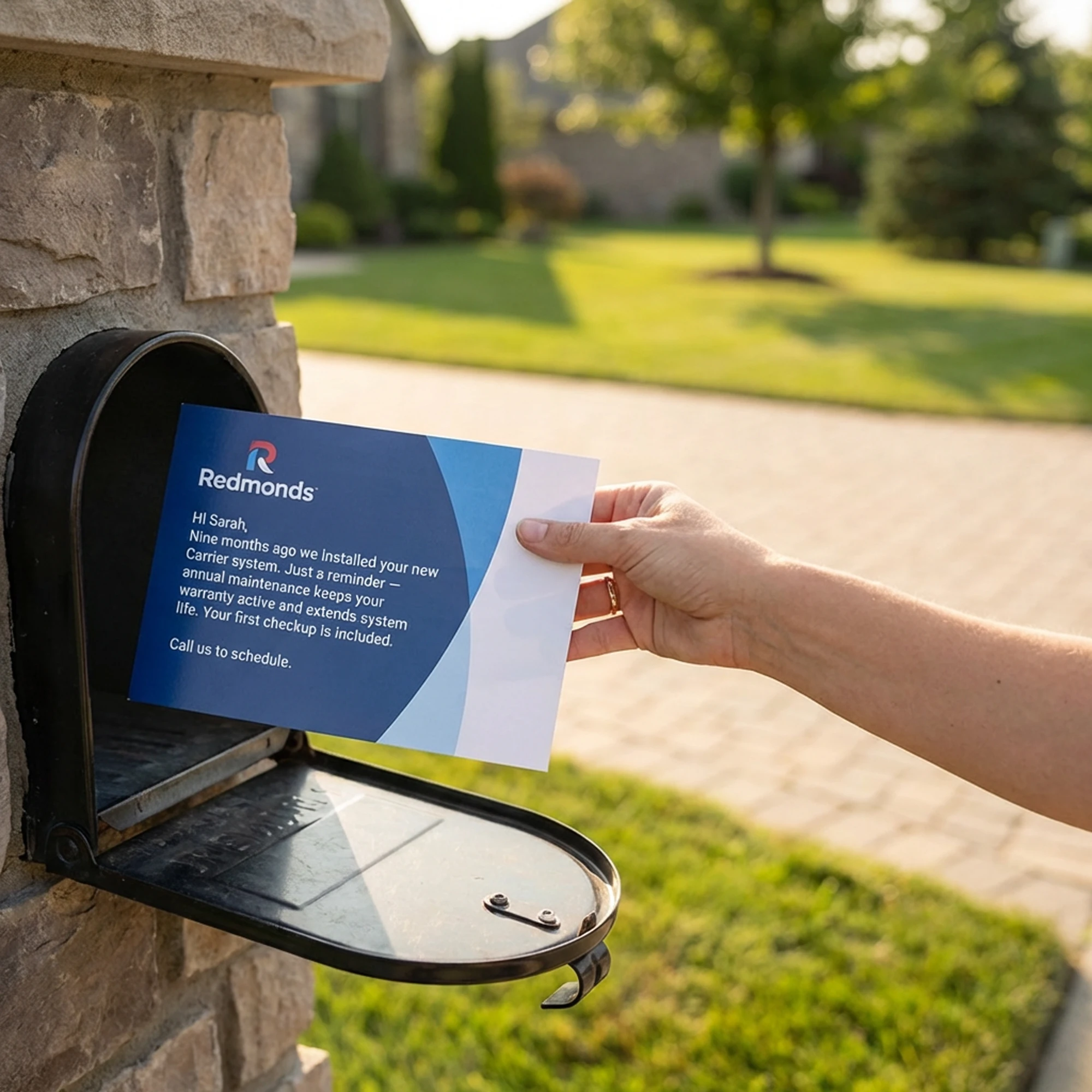
- Annual cadence: Email + (optional) postcard for major equipment categories and long gaps between service events
Direct mail is especially effective for “long gap” services (replacement cycles, annual checkups) because it stays visible in the home longer than an email.
Build the System From Your Existing FSM Data (In 7 Steps)
You already have the raw material: completed job data, dates, service types, equipment notes, and customer contacts inside your field service management platform.
- Choose your first category: start with installs/replacements (highest lifetime value potential).
- Define 4–6 service buckets: installs, major repairs, maintenance, drain/sewer, diagnostics/minor repairs, etc.
- Map the five horizons: decide the purpose of each touchpoint per bucket.
- Write modular templates: build 2–3 message variants per touchpoint (keeps it from feeling automated).
- Set trigger logic: “job completed” + “service type” + (optional) “equipment tag.”
- Pick your channel mix: email + SMS (and postcard where appropriate).
- Measure and refine monthly: reviews, maintenance enrollments, callback rate, booked jobs from follow-ups.
Tip: if your system supports it, tag the job at closeout (install / repair / drain / maintenance) so automation stays clean.
The Maintenance Agreement Bridge
Inside the sequence, the most important milestone is converting a one-time customer into a maintenance agreement customer—because memberships create recurring revenue, guaranteed annual touchpoints, and first call rights on future work.
There’s strong evidence that maintenance agreements create significant “pull-through” revenue. Companies report pull-through work generating anywhere from $1 to $3+ in additional revenue for every $1 of maintenance agreements in place.
Industry program data also supports the idea that service agreement customers contribute materially to total revenue; for example, FieldEdge notes preventive maintenance contracts capturing a meaningful share of HVAC revenue in recent reporting.
Make your maintenance offer feel like protection + priority, not a subscription.
Example positioning block (use your actual details):
- What’s included: annual system check, priority scheduling, safety inspection, and member savings on repairs
- Why it matters: extends equipment life, reduces breakdown risk, catches issues early
- Who it’s for: homeowners who want fewer surprises and faster help when something goes wrong
Why Retention Pays
Bain & Company’s retention research (often attributed to Frederick Reichheld) is widely cited for the idea that increasing retention by 5% can increase profits by 25% to 95%.
The same Bain retention overview also reinforces a core reality: acquiring new customers is far more expensive than keeping existing ones.
And there’s still massive headroom: Workyard cites that only about 30% of homeowners schedule preventative maintenance.
What the Numbers Can Look Like
- HVAC CLV: ~$47,200 estimate (FirstPageSage; also cited by EnerTech USA).
- Retention impact: +5% retention can raise profits by 25% to 95% (Bain).
- Service life: many HVAC components commonly land in the ~15–20 year range with proper maintenance ( HVAC.com).
- Replacement cost range: replacement commonly falls into the ~$7,500–$15,000 range depending on system and scope (R10; HVAC.com provides additional context/ranges).
Estimated example:
Imagine a $3M home services company completing ~3,000 calls/year (an illustrative mix that implies roughly a $1,000 blended average ticket—your numbers may vary). If a post-service sequence improves 24-month “return customer” behavior from 20% to 30% (an internal/industry-informed estimate), that’s 300 additional returning customers.
If those 300 customers average $1,200 in annual follow-on revenue through maintenance plus additional service, that’s ~$360,000 in annual revenue created from customers you already served.
Now layer in replacements. If your system helps you retain even a modest number of additional replacements that would have gone elsewhere—using the cited replacement cost ranges above—the upside grows quickly.
Why Most Companies Never Build This
- The revenue is “invisible”: when a customer calls 14 months later, it looks like the phone “just rang.”
- It requires upfront work: the payoff compounds over months and years, not by Friday.
- Most vendors don’t sell it: many marketing services are built around lead gen, not retention systems that reduce dependence on buying leads.
Start Simple: Launch One Sequence in 7 Days
Don’t build everything at once. Start with installs/replacements and ship a five-touch sequence:
- 48 hours: thank-you + work summary + warranty info (+ review request secondary)
- 1 week: education about the installed system
- 3 weeks: soft maintenance plan introduction
- 3 months: seasonal check-in
- 12 months: anniversary reminder + inspection/renewal offer
Track three things for 90 days: engagement (opens/clicks), maintenance enrollments from the sequence, and callback rate compared to your baseline.
The Compounding Effect
When post-service follow-up becomes part of your operating system, every service call stops being a transaction and starts being an investment. Every completed job adds future revenue potential to a system that runs automatically—without relying on new lead spend to keep the phone ringing.
The $47,000+ lifetime value number isn’t magic. It’s what happens when you build the retention machine that captures it, one completed job at a time.
Next step: choose one category, write the five messages, and launch the first sequence. Then expand one service bucket at a time.
FAQ
What is a post-service follow-up sequence?
A triggered set of messages that starts immediately after a job is completed and continues over time—designed to keep you top-of-mind, educate the customer, and convert one-time calls into repeat revenue.
How long should the sequence run?
Start with 12 months. The real payoff comes from an annual cadence that continues for years (anniversary reminders, seasonal check-ins, and maintenance prompts).
What should the first message say?
Thank them, summarize what was done, clarify any warranty/guarantee details, and provide a single “if anything feels off, reply/call us” instruction. Then (optionally) include a review link as a secondary ask.
How do you segment customers?
By service type (install vs. repair vs. maintenance vs. drain/sewer, etc.), and when possible by equipment tag and service date. One-size-fits-all sequences lose specificity and performance.