
 Most HVAC, plumbing, and electrical companies don’t have a lead problem. They have a follow-up problem.
A residential heating, cooling, plumbing, and electrical company we work with in a mid-sized market was generating plenty of estimates, approximately 180 per month. But once an estimate was presented, the follow-up process was inconsistent at best. Their sales team made one phone call after the estimate, maybe a second if they remembered, and then moved on to the next lead.
If that sounds familiar, it should.
The numbers told a painful story. Only 23% of their estimates were converting into jobs. Industry research consistently shows that a significant percentage of sales occur after multiple follow-up attempts, yet like most home service companies, they had no systematic way to stay in front of prospects once the initial estimate was delivered.
The Real Cost of Inconsistent Follow-Up
Here’s what we uncovered during our initial analysis.
The company’s average estimate value across heating, cooling, plumbing, and electrical services was approximately $4,200. This aligns with industry data showing that residential installation and replacement projects typically fall in the $5,000–$15,000 range, with repairs on the lower end and full system replacements on the higher end (ServiceTitan industry metrics).
With around 180 estimates per month, they were presenting roughly $756,000 in quoted work every month.
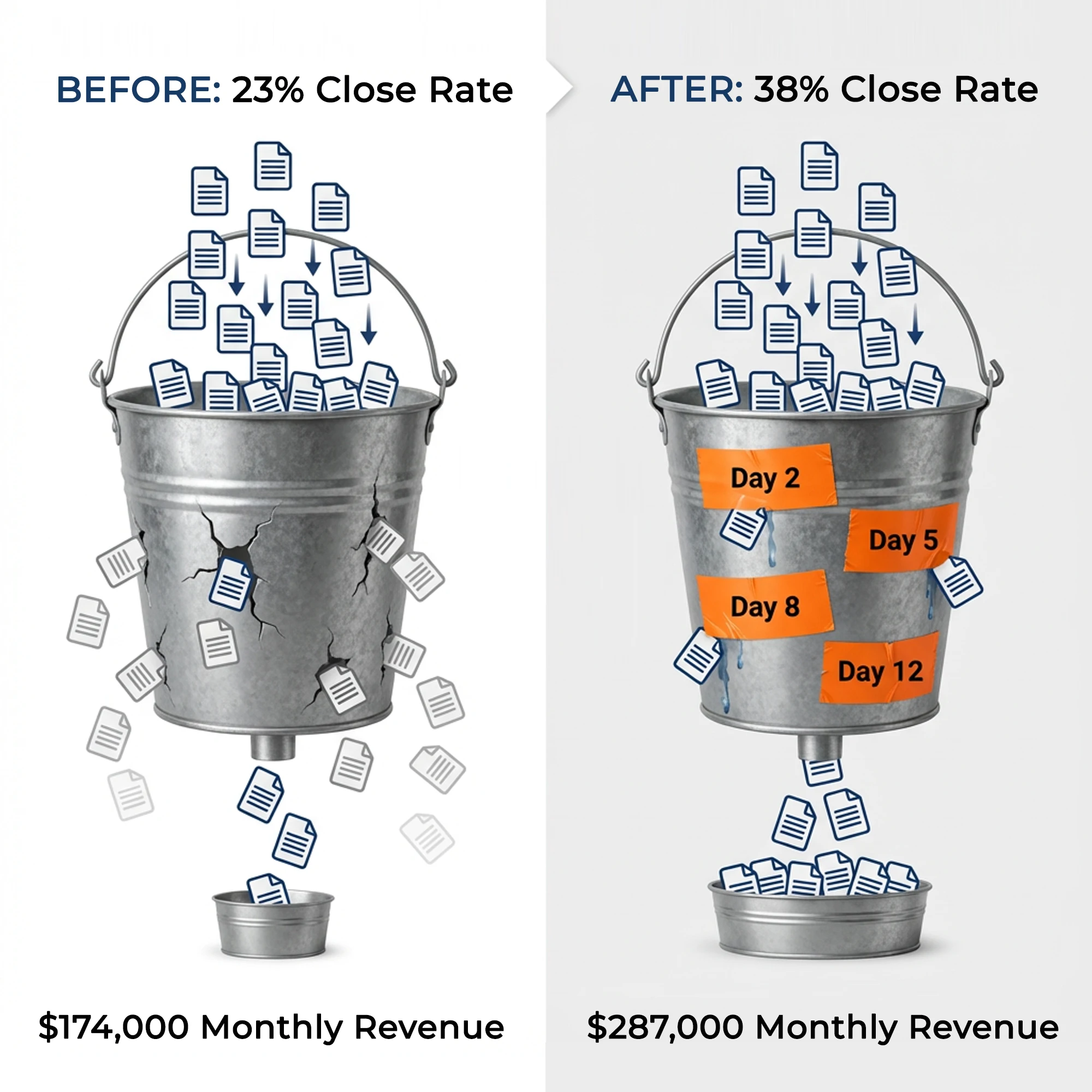
At a 23% close rate, that translated to about $174,000 in monthly revenue.
That meant $582,000 in unsold estimates every single month—projects that homeowners didn’t necessarily reject, but postponed, forgot about, or eventually hired another contractor to complete.
To put that 23% close rate in perspective, a healthy estimate-to-close rate for residential HVAC, plumbing, and electrical contractors typically falls between 40% and 60%. Rates below 40% usually indicate breakdowns in sales process, positioning, or follow-up (WebFX home services benchmarks).
The issue wasn’t lead volume. The revenue opportunity was already sitting in their system.
Building a Follow-Up System That Actually Works
Rather than adding more advertising or pressuring sales reps to “try harder,” we built a system that made consistent follow-up unavoidable.
We implemented an automated workflow using Directus designed to work with virtually any field service management software, without expensive integrations, vendor lock-in, or API access.
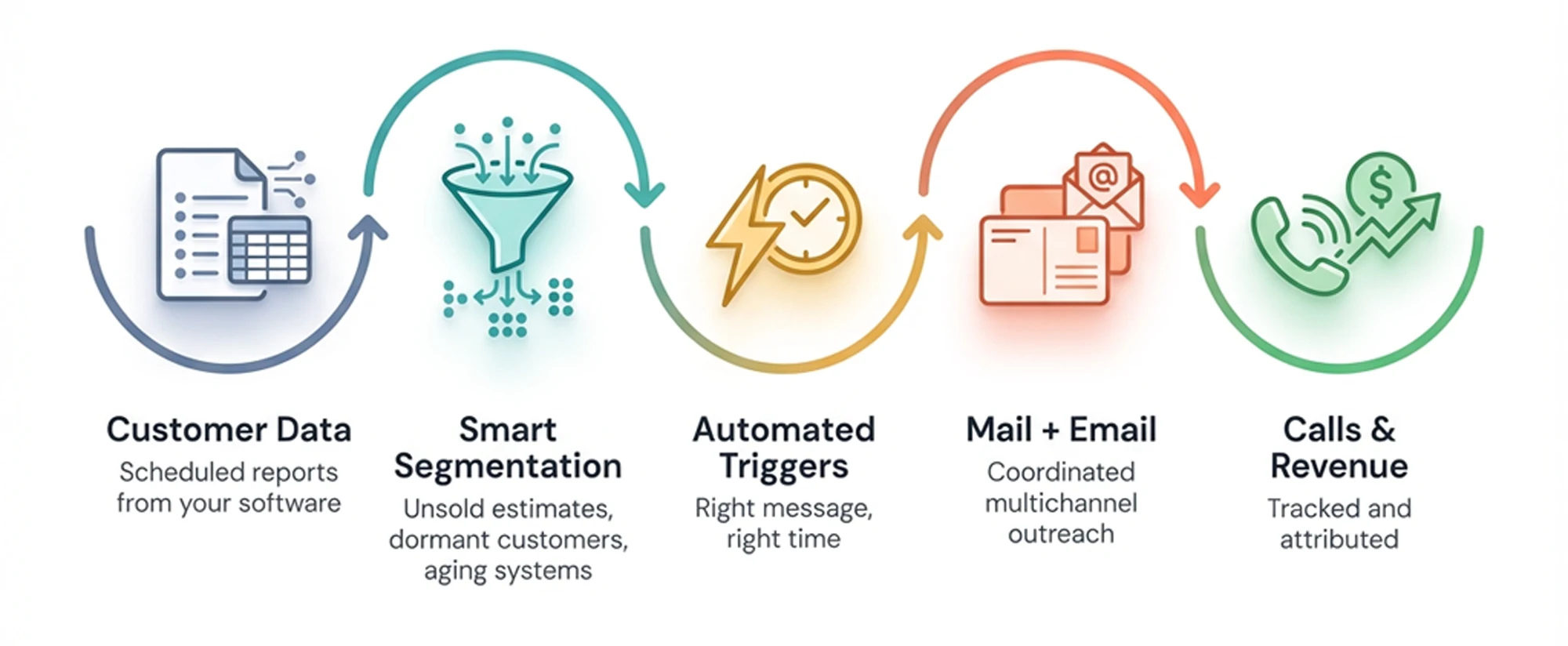 Here’s how the system works.
1. Estimate Data Ingestion
The company’s FSM exports a daily report of presented estimates as a CSV file. That report is automatically emailed to a designated Google Drive folder.
Directus monitors that folder and processes new on set schedule.
2. Intelligent Trigger Logic
When an estimate appears as “presented,” the system evaluates key variables including:
- Estimate value
- Service type (HVAC, plumbing, electrical)
- Customer history
Based on those factors, the appropriate follow-up sequence is triggered automatically.
3. Multi-Touch Follow-Up Sequences
The follow-up process is structured, consistent, and personalized:
- Day 2: A personalized email thanking the homeowner and addressing common concerns related to their specific service.
- Day 5: A second email featuring customer testimonials relevant to the type of project quoted.
- Day 8: For estimates over $5,000, a physical direct mail card is automatically sent with financing and reassurance messaging.
- Day 12: A final email offering to answer questions or clarify next steps.
Multi-touch, multi-channel follow-up matters. Integrated approaches across email, phone, and direct mail consistently outperform single-channel efforts, producing significantly higher response rates (Cube Creative follow-up research).
4. Human Handoff Rules
When a prospect replies to any message, the automated sequence immediately pauses and the sales team is notified. No one continues receiving automated follow-ups after they’ve engaged.
5. Sales Visibility & Context
Every interaction is tracked in a central dashboard. Sales managers can quickly see which estimates are actively in follow-up, which have gone quiet, and which require personal outreach.
Because estimates are connected to customer history and prior communication, sales reps always have full context before making contact.
If an estimate goes 30 days without a response, the system flags it for a final personal outreach. Typically a low-pressure check-in call rather than a sales push.
Results That Changed the Business
Within 90 days, the results were undeniable.
The company’s close rate increased from 23% to 38%—a 15-point improvement that moved them much closer to healthy industry benchmarks.
Here’s the transparent math:
- Same ~180 estimates per month
- Same ~$4,200 average estimate value
Before: ~$174,000 closed per month
After: ~$287,000 closed per month
That’s an additional $113,000 in monthly revenue from the exact same number of leads.
On an annualized basis, the upside exceeded $1.3 million. Conservatively, approximately $850,000 in revenue was directly recovered in the first year from improved follow-up alone.
No additional ad spend. No increase in lead volume.
Just better execution.
Perhaps the biggest shift wasn’t financial. The sales team stopped relying on memory, sticky notes, and “I’ll call them later.” Instead, they focused on having better conversations with homeowners who were already warm.
Most homeowners weren’t saying no, they were busy. Research shows that when home services consumers make phone contact, roughly 40% ultimately move forward with a purchase, reinforcing how important timely, persistent follow-up is (Invoca home services statistics).
Beyond Immediate Results
Once the system was in place, new opportunities emerged.
The company can now see patterns across services: which follow-up messages perform best for HVAC versus plumbing, how decision timelines differ for electrical projects, and which estimate sizes require longer nurturing cycles.
They’re now extending the same workflow infrastructure to:
- Service agreement renewals
- Seasonal HVAC maintenance reminders
- Reactivating dormant plumbing and electrical customers
The system they built to recover unsold estimates became the backbone of their entire customer communication strategy.
Because it relies on simple CSV exports, something every FSM can generate, it works whether a company uses ServiceTitan, Housecall Pro, Jobber, or a custom platform.
No vendor lock-in. No expensive integrations. No technical roadblocks.
The Revenue Is Already There
Most home services companies already have the leads they need.
If you’re writing estimates for heating and cooling replacements, water heaters, electrical panels, or plumbing projects that don’t close, the revenue opportunity is already sitting inside your FSM.
You don’t need more leads.
You need a system that ensures every good opportunity gets the follow-up it deserves.
Unsold estimates often represent six figures or more in recoverable revenue. If you’re curious what that number looks like for your business, we can map it out, and determine whether a systematic follow-up process would close the gap.
Not ready to talk yet? Pull your last 90 days of presented estimates and look at how many never received more than one follow-up. The opportunity will be obvious.