
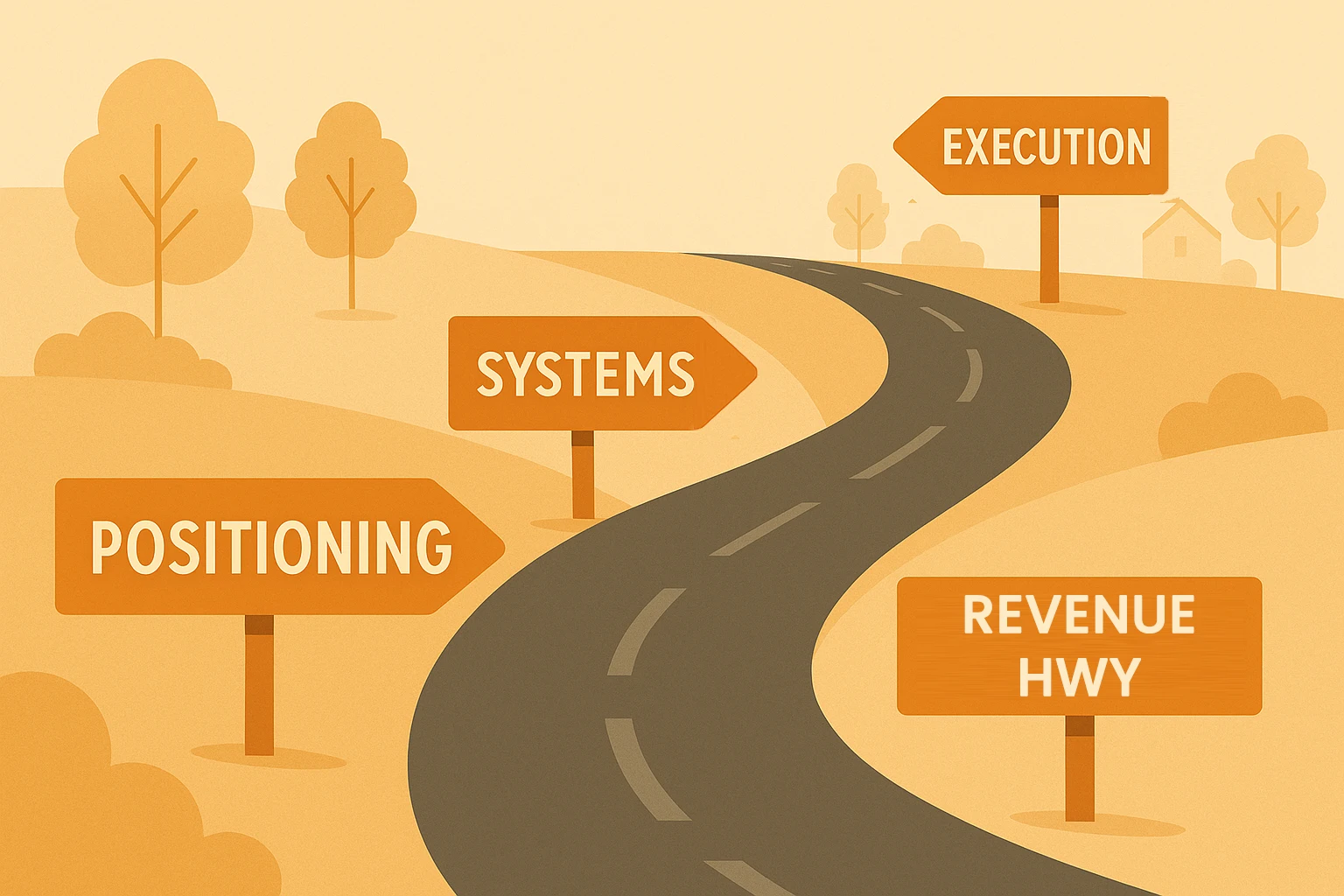
Why Most Home Service Companies Are Stuck in Execution Mode
What separates the HVAC or plumbing company doing $5 million a year from the one doing $50 million in the same market? Here’s a hint:
It’s not the number of Google Ads they run. It’s not their posting schedule. And it’s definitely not the shiny new marketing automation tool they bought last month.
The real difference is simple: one company has a strategy. The other has tactics.
In this guide, we’ll break down why so many home service companies stay stuck in execution mode, and how a strategic marketing foundation drives consistent, predictable, profitable growth.
1. The Execution Trap That Keeps Companies Stuck
Walk into any home service company’s marketing meeting and you’ll hear versions of the same conversation:
“We need more leads.”
“Can we increase our Google Ads budget?”
“What about LSA?”
“Should we try direct mail?”
This is the sound of a company stuck in execution mode, running from one tactic to the next without ever clarifying the bigger picture.
After 18 years in marketing for the trades, I see this constantly: companies spending $30K–$50K per month with no target customer profile, no pricing strategy, no positioning, and no measurable system for what actually drives profitable revenue.
They’re not running a marketing operation.
They’re running an expensive experiment.
2. Strategy vs. Tactics: The Million-Dollar Difference
Here’s a simple, real-world comparison:
Tactic: “We’re sending 10,000 direct mail pieces this month.”
Strategy: “We’re positioning ourselves as the premium provider for homeowners 55+ in the northwest suburbs; people who value reliability over price. Direct mail is our lead-in channel because this audience responds 3x better to physical mail than digital ads.”
See the difference? Tactics are what you do. Strategy is why you do it, who it’s for, and how it fits into your broader revenue architecture.
Without strategy, tactics become noise… expensive, time-consuming noise.
3. The Three Pillars of Strategic Marketing (That Most Companies Ignore)
1. Market Position Before Market Presence
Before you spend a dollar on advertising, answer:
- Who exactly is our ideal customer? (Not “homeowners.”)
- What problem do we solve better than anyone else?
- Why should customers pay our premium price?
If you can’t answer these clearly, your marketing will default to price competition, the death spiral of home services.
2. Systems Before Campaigns
A campaign delivers leads for a month. A system delivers revenue for years.
Strategic companies build:
- Automated follow-up sequences
- Customer retention programs
- Referral systems
- Reputation management workflows
Tactical companies chase the next “silver bullet.” Strategic companies build engines.
3. Metrics That Actually Matter
Which matters more?
A) 500 leads
B) $47 cost per acquisition, 2.3x return on ad spend, and 67% of revenue from existing customers
If you chose A, your mindset is tactical.
Lead count doesn’t matter. Profitability does.
4. Why Lead Generation Vendors Keep You Tactical
It’s not that vendors are bad. They just get paid to execute tactics, not design strategy.
- PPC agencies want to run your Google Ads
- Social companies want to post on Facebook
- Direct mail houses want to print postcards
No one is asking: “Does any of this align with your positioning, pricing goals, and target customer?”
This is why companies end up with five vendors, mixed messages, and marketing costs that balloon to 12–15% of revenue.
Strategy-first companies stay in the optimal 7–10% range because their dollars work harder.
5. The Strategic Shift: From Vendor Collection to Revenue Architecture
Imagine your marketing engine looking like this:
- Budget allocation is intentional—40–60% digital, 15–25% traditional, 10–20% partnerships based on documented performance.
- Your premium positioning supports 20–40% higher prices while improving close rates.
- Your channels reinforce each other—trucks, mailers, reviews, ads, and sales scripts all say the same thing.
- You measure profitability, not lead count.
This is not fantasy. This is what happens when you move from tactical execution to strategic revenue architecture.
6. The First Step Out of Execution Mode
If you recognize your company in this article, here’s your starting point:
Pause all new marketing initiatives for two weeks.
Instead, answer these five questions with real data:
- Who are our most profitable customers?
- What’s our true cost per acquisition across all channels?
- What percentage of revenue comes from existing customers?
- What’s our average customer lifetime value?
- Why do customers choose us over cheaper options?
If you don’t know these, you’re not ready for more tactics. You need strategy.
7. The Strategy-First Model
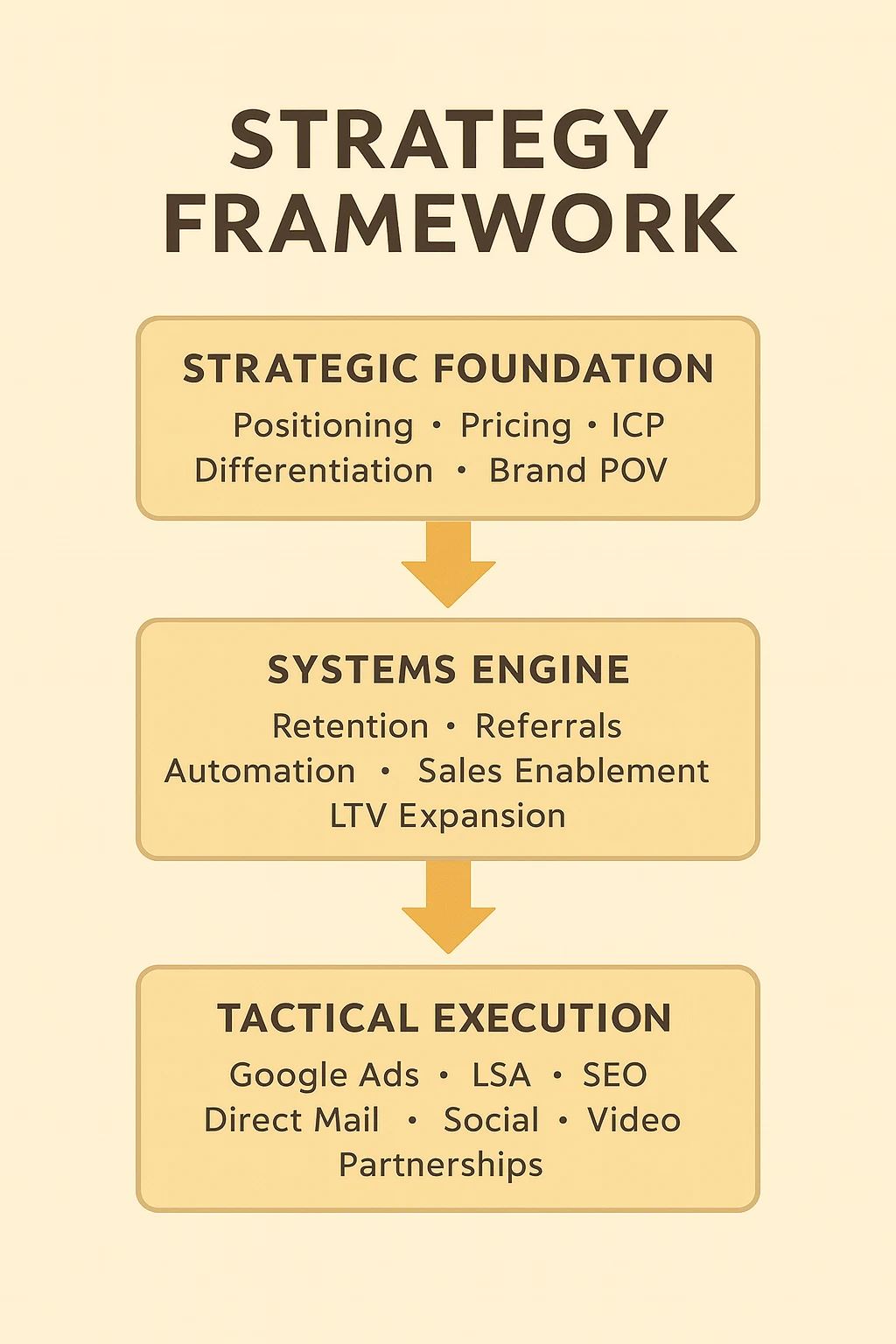
This is the model the $50M companies follow—intentionally or not.
Strategy drives systems. Systems drive tactics. Tactics execute the strategy.
Most companies skip the top two layers and wonder why growth stalls.
8. Ready to Build a Strategy That Scales?
Most HVAC, plumbing, and electrical companies will spend the next decade jumping from tactic to tactic, hoping something finally “works.”
A select few will step back, build a strategic foundation, and dominate their markets with predictable, profitable growth.
If you’re ready to stop competing on price and start commanding it, let’s talk.
Service Labs Group works exclusively with established home service companies ($2M–$10M) ready to build a premium, strategy-first marketing engine.
→ Explore the Marketing Budget (7–10%) Framework
→ Learn How Premium Positioning Increases Prices 20–40%
Your competitors are playing checkers.
It’s time to start playing chess.
Table of Contents
The Execution Trap That Keeps Companies Stuck
Strategy vs. Tactics: The Million-Dollar Difference
The Three Pillars of Strategic Marketing
Why Lead Generation Vendors Keep You Tactical
The Strategic Shift: From Vendors to Revenue Architecture
The First Step Out of Execution Mode