
Month: December 2025

The psychology of service pricing

The Psychology of Premium Service Pricing

The psychology of service pricing

Why apologizing for your prices quietly destroys trust, and how confident contractors charge 20–40% more while closing faster

I watched a master plumber with thirty years of experience stumble over his own estimate last week.

He’d just diagnosed a complex issue that would have taken most technicians twice as long to identify. His solution was elegant. His price was fair.

And the moment he said the number, he flinched.

“I know that sounds like a lot, but…”

That single word—but—cost him the job.

Not because his price was too high. It wasn’t. He lost because the customer watched him apologize for his own expertise and thought:

If he doesn’t believe he’s worth it, why should I?


In this article, you’ll learn:

  • Why apologizing for your price creates distrust instead of reassurance
  • How confident contractors charge 20–40% more and close faster
  • The language patterns that quietly sabotage premium pricing
  • What to change immediately if you want to stop competing on price

The Apology Reflex (And Where It Comes From)

Most contractors don’t realize they’re apologizing for their prices.

It’s a learned reflex, shaped by years of lowball competitors, price shoppers, and the cultural idea that trades work should always be “affordable.” Over time, higher prices start to feel like something that needs to be justified rather than something that signals value.

Psychologically, this creates a negative price association. You begin to treat your price as a problem to overcome instead of a statement of confidence.

Here’s the uncomfortable truth: apologizing doesn’t make customers feel better about paying.

It makes them suspicious.

People rely heavily on confidence signals when evaluating services they can’t objectively measure. When a surgeon quotes a fee without hesitation, you assume the procedure requires that investment. When a contractor hedges, qualifies, or softens the number, customers assume the price is inflated—or negotiable.

The apology doesn’t lower resistance. It creates it.


The Certainty Premium

Behavioral economists use the term certainty premium to describe something powerful: people willingly pay more for outcomes they believe are guaranteed.

This is why companies with clear processes, decisive recommendations, and confident communication routinely charge 20–40% more than competitors who describe themselves as “flexible on price.”

Flexibility sounds customer-friendly. In practice, it signals uncertainty.

And uncertainty is expensive.

Consider the difference:

“I can probably get that done for around twelve hundred, give or take.”

Versus:

“This repair is $1,247. We’ll have it completed by Thursday, and it’s guaranteed for two years.”

Same repair. Same price. Completely different psychology.

The second version feels like a better deal—not because it’s cheaper, but because certainty itself has value.


Why Customers Don’t Trust “Fair” Prices

There’s a counterintuitive truth at the heart of premium pricing:

In service businesses, higher prices are often trusted more than lower ones.

Not always. Not without context. But when quality can’t be evaluated before purchase, price becomes a proxy for competence.

Customers can’t see inside their walls. They don’t know if a something really needs replacing. They can’t tell whether a repair will last ten years or fail in six months.

So they evaluate what they can see:

  • Your price
  • Your presentation
  • Your confidence

When you position yourself in the middle of the market and apologize for it, you create ambiguity. You’re not the budget option, but you’re not acting like the premium choice either.

Ambiguity feels risky.

The companies charging 40% more aren’t hiding their prices better. They’re owning them.


From Defensive Pricing to Offensive Pricing

Stopping the apology isn’t about charging more for the same work.

It’s about changing how you think about pricing altogether.

Defensive pricing starts with costs. You calculate inputs, add a margin, and prepare to justify the number.

You’re already anticipating objections before the customer speaks.

Offensive pricing starts with outcomes. You price the certainty, the solved problem, the peace of mind, and the guarantee.

A customer calling at 10 PM with a failed water heater doesn’t care about your overtime rate. They care about having hot water for their kid’s bath in the morning.

Pricing the outcome changes the entire conversation.

This isn’t manipulation. It’s accuracy.


The Language of Premium Positioning

Customers recognize apology language instantly, even if they can’t name it:

  • “only”
  • “just”
  • “around”
  • “roughly”
  • “I can probably”
  • “we might be able to”

Compare that with the language of confidence:

  • “This is”
  • “Your investment is”
  • “We guarantee”
  • “You’ll have”

The difference isn’t aggression. It’s clarity.

You’re not pressuring anyone. You’re stating reality without hedging. The price is what it is. The outcome is what it is. The decision belongs to the customer.

Removing ambiguity often increases close rates, even at higher prices, because you’ve made the decision easier.


Three Changes You Can Make This Week

  1. Remove hedging language from estimates.
    If you wouldn’t say “probably” about the repair itself, don’t say it about the price.
  2. Anchor outcomes before price.
    Lead with what’s being solved, how long it will take, and what’s guaranteed, then state the number.
  3. Audit where your pricing is competitor-based.
    If your prices are set by what others charge instead of what certainty you provide, confidence will always feel forced.

Building Confidence That’s Actually Warranted

None of this works if you’re faking it.

Customers can smell performative confidence, and it backfires.

The goal isn’t to act confident about prices you don’t believe in. The goal is to build a business where your prices genuinely reflect your value.

That means understanding what your expertise saves customers in misdiagnosis, callbacks, downtime, and failed repairs. It means recognizing that twenty years of experience has real market value—even if you’ve never priced it that way before.

Most contractors don’t do this math. They price based on competitors, gut feel, or what feels comfortable.

Then they apologize.

When you understand your actual value, not just your costs, confidence stops being performance.

It becomes accuracy.


What Happens When You Stop Apologizing

The first time you quote a premium price without hedging, some customers will balk.

That’s fine.

They were likely price shoppers who would have been unprofitable anyway.

Other customers will simply say yes. No negotiation. No pushback. Just acceptance.

Those are the customers you want.

They trust your expertise, refer others like themselves, and make your business easier, and more profitable, to run.

Higher margins fund better training, better systems, and better customer experience. That investment justifies higher prices, which attracts better customers.

And eventually, you stop spending your career apologizing for your own expertise.

There are few things more liberating than that.


Where to Go From Here

If you’re losing jobs you should be winning, your pricing probably isn’t the real problem.

Your positioning is.

At Service Labs Group, we work with established HVAC, plumbing, and electrical companies to identify where confidence breaks down, and rebuild pricing, messaging, and marketing systems that support premium positioning.

If you’re ready to stop competing on price and start closing better jobs at higher margins, that’s the conversation we should be having.

The Psychology of Premium Service Pricing Read More »

Home Services Unique Value

How to Identify Your Company’s Unique Value

Identify Your Company’s Unique Value

When you say “quality work and great customer service,” you’re not reassuring customers, you’re telling them you’re interchangeable.

And interchangeable companies don’t set prices. The market does.

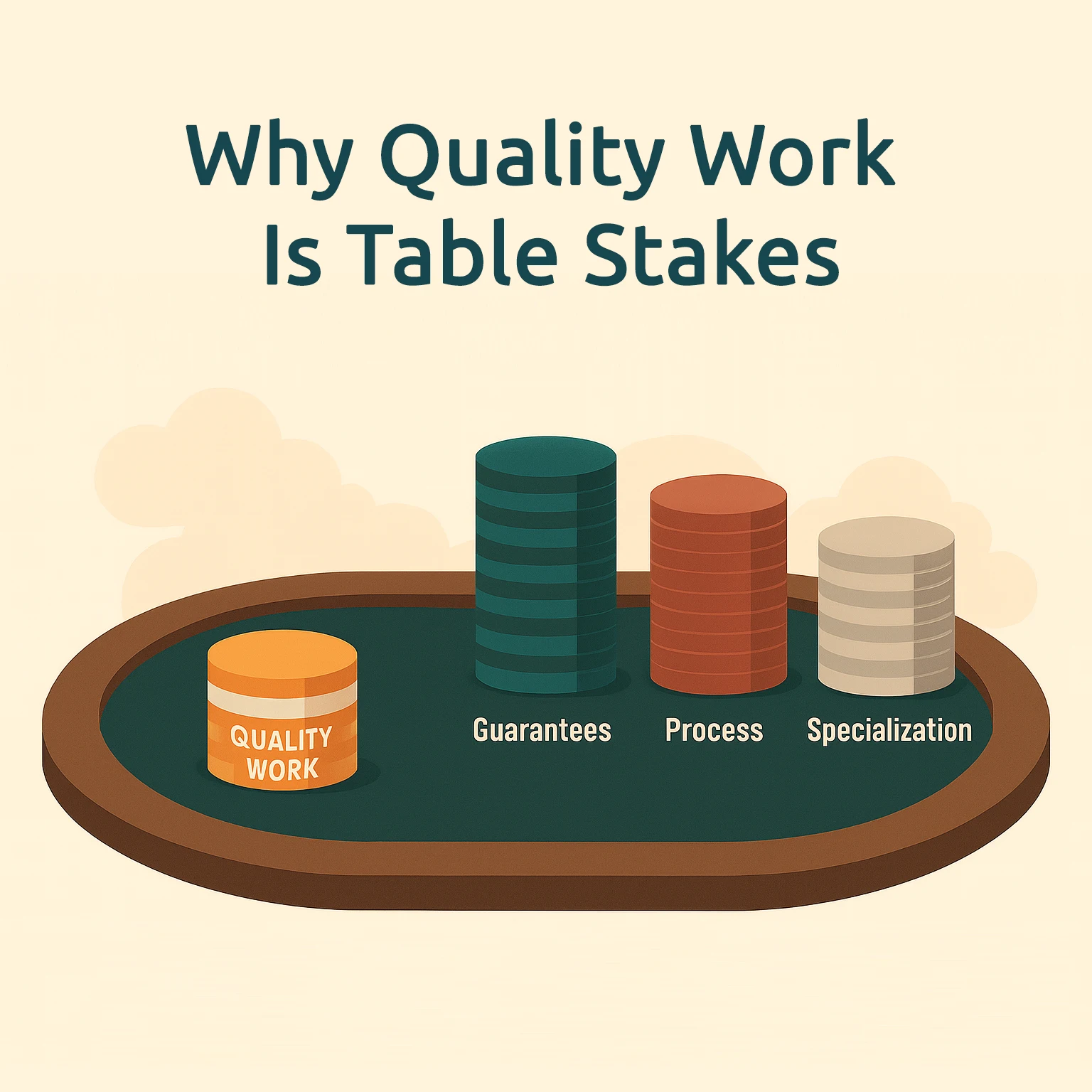
Every HVAC company claims quality work. Every plumber promises reliability. Every electrician swears they’re the most professional. These claims have become so universal they’ve lost all meaning. They’re table stakes, not differentiators.

The result? You compete on price. And competing on price is a race where everybody loses, except the customer who gets to squeeze your margins thinner and thinner.

Here’s what I’ve learned working with home service companies for nearly two decades: Every company has something genuinely unique about how they operate. The problem isn’t that differentiation doesn’t exist. The problem is that most owners are too close to their own business to see it.

This article is for owners of established HVAC, plumbing, and electrical companies who are tired of winning jobs and losing margins, and know there has to be a better way to compete than being “a little nicer” or “a little cheaper.”

Why Generic Claims Commoditize Your Business

Before we dig into finding your real differentiator, let’s make the problem crystal clear: generic marketing claims don’t just fail to help you, they actively hurt you.

When a homeowner compares three companies and all three claim “quality work, fair prices, and professional technicians,” they have no meaningful way to distinguish between options. So they default to something else:

  • The cheapest quote
  • The fastest callback
  • A vague recommendation (“My neighbor used them once”)
  • Or the company with the best availability

Your marketing has essentially told them: “We’re interchangeable, so choose based on something other than our actual capabilities.”

That’s the opposite of what marketing should accomplish. Clear differentiation doesn’t just justify higher prices, it filters out bad-fit leads before the phone ever rings.

The Differentiation Discovery Framework

This isn’t a quick branding exercise. It requires honest reflection and, ideally, input from people who know your business—employees, long-term customers, even vendors.

The goal is to uncover what’s genuinely different about your operation, not to invent something that sounds good.

How to Run This Exercise (So You Actually Get Answers)

  • Block 60 minutes (no phone, no email)
  • Answer each question in writing (not in your head)
  • Highlight anything measurable (numbers, standards, guarantees, response times, completion rates)
  • Circle anything customers mention unprompted (“You guys always…”, “Nobody else…”, “I called because…”)

If you can’t explain your differentiator in one sentence, it’s not a differentiator yet, it’s a rough idea that needs sharpening.

Question 1: What do you do that you assumed everyone does, but they don’t?

What this reveals: Hidden operational advantages you’ve stopped noticing.

This is usually where the gold is buried.

I worked with a plumbing company owner who mentioned, almost as an afterthought, that his techs always lay down drop cloths and wear booties, and they take “before and after” photos of every job site.

“Doesn’t everyone do that?” he asked.

No. Not even close. Most companies don’t have that discipline. But because he’d done it for years, he stopped seeing it as remarkable.

Think about your processes, your hiring standards, your follow-up procedures, your warranty policies. What feels “normal” to you that would surprise customers if they knew how different it was from competitors?

Ask your employees: “What do we do here that you’ve never seen at other companies?” Their answers might shock you.

Question 2: What specific problem do you solve better than anyone in your market?

What this reveals: Where you can own a niche and avoid price competition.

Notice the word specific. Not “we solve all problems well.” That’s meaningless.

Maybe you’ve become the go-to company for complex commercial retrofits because you invested in specialized training. Maybe you’ve figured out how to handle historic homes without damaging original materials. Maybe you’ve developed a system for completing whole-house rewires in half the typical time.

The key is specificity. “We’re great at electrical work” is nothing. But:

“We specialize in panel upgrades for homes built before 1970, and we’ve developed a process that minimizes drywall repair.”

That’s a real differentiator, especially if it reduces mess, disruption, and unexpected costs.

Ask yourself:

  • What jobs do you take that competitors turn down?
  • What problems do you see other companies repeatedly botch?
  • What calls make you think, “They came to the right place”?

Question 3: What would your best customers say if asked why they keep calling you?

What this reveals: The true reason you win (which is often different than what you think).

Not what you hope they’d say. What they actually say.

This requires real conversations, not assumptions. Call five of your best repeat customers, the ones who’ve used you multiple times and referred others, and ask them directly:

“I’m trying to understand what makes us different from other companies. Why do you keep calling us instead of shopping around?”

Listen carefully. They’ll tell you things you’ve never considered. And because they’ve likely used competitors, they can articulate differences you can’t see from the inside.

One owner I worked with was convinced his differentiator was technical expertise. But when he called customers, they kept mentioning something else entirely:

“Your office staff actually calls back when they say they will.”

That became a central piece of positioning: same-day callbacks, guaranteed. It didn’t just sound good, it eliminated a real frustration customers were used to tolerating.

Question 4: What have you invested in that competitors haven’t?

What this reveals: Advantages you can prove, if you translate them into customer outcomes.

Investment creates differentiation. But only if you translate that investment into customer benefit.

Did you spend money on advanced diagnostic equipment? That’s not the differentiator. The ability to pinpoint problems faster, with less guesswork and fewer return visits, that’s what customers care about.

Did you invest in ongoing training? Nobody cares about your training budget. But they do care that your techs are certified to work on the specific brand of equipment in their home, reducing the risk of warranty-voiding mistakes.

Did you invest in better trucks and inventory management? “Nice trucks” means nothing. But:

“We stock 300 common parts on every truck, so 90% of repairs are completed on the first visit.”

That solves a real customer frustration and shortens the sales cycle because it’s easy to understand.

Action: List your top 5 investments from the last 3 years. For each one, write the customer outcome in plain language: faster, cleaner, fewer trips, less risk, better options, more certainty.

Question 5: What do you refuse to do that competitors commonly do?

What this reveals: Values and standards the right customers will pay more for.

Sometimes what you won’t do is as powerful as what you will do.

Do you refuse to hire techs who haven’t passed a thorough background check, even though it makes hiring slower? Do you refuse to quote repairs without a full system inspection, even though it means some customers go elsewhere? Do you refuse to take on certain types of work because you’ve seen it done poorly too many times?

These “refusals” often represent genuine values that the right customers will pay more for. The customer who values a thorough background check will pay a premium for the peace of mind. The customer who’s been burned by a quick-fix that failed will appreciate a company that insists on doing it right.

Your constraints and standards are differentiators, if you communicate them as customer benefits rather than operational details.

Testing Your Differentiator (Before You Build Marketing Around It)

Once you’ve worked through these questions, you should have a few candidates for genuine differentiation. Before you plaster them across your website, apply these three tests:

The “Only We” Test: Can you honestly say “We’re the only company in this market that _______”? If three competitors could make the same claim, it’s not a differentiator.

The “So What” Test: Does it matter to customers? Being the only company with purple trucks is unique but irrelevant. Being the only company that offers Saturday service with no premium pricing might matter enormously to dual-income families.

The “Prove It” Test: Can you demonstrate the difference with evidence: testimonials, data, guarantees, visible processes, photos, a checklist, a documented standard? A differentiator you can’t prove is just another empty claim.

From Discovery to Positioning

Finding your differentiator is only the first step. The harder work is weaving it into everything: your website, truck wraps, phone scripts, follow-up emails, proposal templates, and how your team talks about what you do.

But that work becomes dramatically easier once you know what makes you genuinely different. You’re no longer grasping for marketing language. You’re simply telling the truth about your business in a way that attracts customers who value what you offer.

And those customers don’t shop on price. They’re looking for a company that reduces risk, solves a specific problem, communicates clearly, and delivers a predictable outcome.

That’s how you command premium pricing: not by claiming you’re better, but by proving you operate differently in ways customers actually care about.

Optional Next Step (If You Want a Second Set of Eyes)

If you run this framework and end up with a handful of “maybe” differentiators, here’s a simple way to pressure-test them:

  • Write each differentiator as a one-sentence claim.
  • Write the customer benefit in one sentence.
  • List how you can prove it (data, guarantee, photos, process, testimonials).

If you want help tightening that into a clear positioning statement (the kind that attracts premium customers and filters out price shoppers), I’m happy to take a look and tell you what’s strongest, what’s weak, and what’s hard to defend.

How to Identify Your Company’s Unique Value Read More »

Why Quality Work Is Table Stakes

Why “Quality Work” Isn’t a Differentiator for Home Service Companies

Quality Work Is Table Stakes

If you run an established HVAC, plumbing, or electrical company and still feel pressure to compete on price, this is for you.

Pull up the websites of five home service companies in your market. I’ll wait.

Now tell me how many of them mention “quality work,” “exceptional service,” or “customer satisfaction.” My guess? All five. Maybe they threw in “family-owned” and “serving the community since [year]” for good measure.

Here’s the uncomfortable truth: when everyone says the same thing, nobody is saying anything at all.

The Quality Trap

I’ve talked to hundreds of home service business owners over the past 18 years. Nearly all of them genuinely believe their work quality sets them apart. And honestly? They’re probably right.

They likely do better work than at least some of their competitors.

But that’s not the problem.

The problem is that quality work is table stakes, not a differentiator. When a homeowner calls for a new HVAC system, a plumbing repair, or an electrical upgrade, they aren’t hoping you’ll do quality work. They’re assuming it.

The alternative, shoddy work, isn’t even on the table in their mind.

Claiming quality work as your differentiator is like a restaurant advertising, “We serve food that won’t make you sick.” Technically true. Completely meaningless.

Why This Happens in Home Services Marketing

Business owners default to “quality work” messaging for a few reasons.

First, you’re too close to your own business. You see the callbacks your competitors generate. You know the shortcuts other companies take. You’ve fixed enough botched jobs to understand what good work actually looks like. That knowledge is a competitive advantage, just not in the way you’re communicating it.

Second, it’s safe. Nobody is going to argue with “quality work.” It’s vague enough to be true and broad enough to apply to everything. That safety is exactly what makes it useless as a positioning strategy.

Third, referrals have masked the problem. When most of your business comes from repeat customers and word of mouth, positioning takes care of itself. Those customers already know your value. The moment you need to attract strangers—through your website, Google Ads, or local SEO—generic messaging collapses.

The Differentiation Test

Real differentiation passes a simple test:

Could your competitor say the exact same thing and have it be equally true?

“We do quality work.” Could a competitor say that? Of course.

“We’re family-owned and operated.” Could a competitor say that? Probably.

“We’ve been in business for 20 years.” Could a competitor say that? Many could.

These aren’t differentiators. They’re expectations—the minimum requirements to even be considered.

Now consider these statements:

“We guarantee same-day service for any call received before noon, or your diagnostic fee is waived.”
This removes scheduling uncertainty and shifts risk away from the homeowner.

“Every technician completes 80 hours of annual training—four times the industry average.”
This directly addresses the fear of an inexperienced tech being sent to their home.

“We show you the problem on video before we quote the repair. No trust required.”
This eliminates skepticism by replacing belief with evidence.

Could competitors say these things? Only if they actually do them. That’s differentiation.

What Actually Differentiates a Home Service Company

True differentiation comes from specificity. It comes from making choices your competitors haven’t made, or won’t make.

Process Differentiation

How you deliver the service matters as much as the service itself. Homeowners remember the experience long after the repair is finished.

Do you have a documented process that creates a noticeably different experience? That might include how you protect the home, how often you communicate during a project, or how you handle follow-up after the job.

The process itself can be proprietary. Name it. Own it. “The SafeHome Installation Process” sounds specific and intentional, even if the individual steps feel obvious to you. Specificity creates perceived value.

Guarantee Differentiation

Anyone can offer a guarantee. Very few make guarantees specific and meaningful enough to influence buying decisions.

“100% satisfaction guaranteed” means nothing because there’s no definition of satisfaction and no clear remedy.

“If your new system doesn’t reduce your energy bill by at least 20% in the first year, we’ll refund the difference” means something. It’s measurable. It implies confidence. It shifts risk away from the homeowner.

Strong guarantees feel uncomfortable. That’s intentional. If you’re not willing to stand behind a specific outcome, customers have no reason to believe you’ll deliver it.

Specialization Differentiation

Generalists compete on price. Specialists command premiums.

You don’t need to turn away most work to specialize in your messaging. But “We specialize in historic home electrical upgrades” attracts a very different customer than “Full-service electrical contractor.”

The first signals expertise. The second signals availability.

Specialization can be based on property type, service type, or customer type. The key is focus. Focus creates trust, and trust reduces price resistance.

Transparency Differentiation

The home service industry has a trust problem. Homeowners expect to be sold to.

Radical transparency—showing customers exactly what you see, explaining why something needs repair, and educating before asking for a decision—flips that expectation on its head.

Video inspections, detailed reports, and side-by-side photos turn skepticism into confidence. You’re no longer asking the customer to trust you. You’re letting them verify the problem themselves.

The Premium Positioning Connection

Differentiation isn’t about sounding smarter than your competitors. It’s about escaping commodity pricing.

When you’re undifferentiated, you’re interchangeable. Interchangeable companies compete on price.

When you’re differentiated, comparison shopping becomes harder. You’re no longer one of five identical options. You’re offering a distinct value proposition.

We’ve seen home service companies raise prices by 20–40% while maintaining, while improving close rates once their differentiation is clearly articulated. Premium positioning doesn’t repel good customers. It attracts the right ones.

The Hard Part

Finding your real differentiator requires honesty.

It may mean investing in training competitors avoid. It may mean offering guarantees that feel risky. It may mean saying no to work that doesn’t fit your specialty.

Most companies won’t do this. They’ll keep saying “quality work” and wonder why margins stay tight.

That’s good news for you. Their reluctance to differentiate is your opportunity.

Your Next Step

Audit your current messaging, your website, proposals, truck wraps, and sales conversations.

For every claim you make, ask: Could a competitor say this and have it be equally true?

If the answer is yes, it’s not a differentiator.

Then ask the harder question: What do we actually do differently? Not better. Differently.

If you want an outside perspective, this is exactly what we help established home service companies uncover and articulate. A clear differentiation strategy doesn’t just improve marketing, it makes sales easier and price objections rarer.

Quality work matters. It’s just not enough anymore.

Why “Quality Work” Isn’t a Differentiator for Home Service Companies Read More »

Home Services Marketing Audit Checklist

The Home Services Marketing Audit Checklist

Home Services Marketing Audit

15 Questions to Identify What’s Actually Working

If you’re running an established HVAC, plumbing, or electrical company in the $2M–$10M range, you already know the frustration: you’re spending real money on marketing, some of it works, some of it doesn’t, and you can’t clearly see why.

You’re not struggling because of a lack of effort. You’re struggling because of a lack of clarity.

The most successful companies I work with aren’t the ones hustling the hardest. They’re the ones with visibility into what’s actually producing booked jobs, where the inefficiencies are, and which opportunities will generate premium customers rather than price shoppers.

This 15-question audit is designed to give you that clarity. These aren’t theory-based questions. They’re the exact blind spots I see costing established home service companies hundreds of thousands of dollars in missed opportunity every year.

Grab a notebook. Be candid. The questions you can’t answer are the ones that will make you money.

The 15-Question Marketing Audit

SECTION 1: Visibility, Tracking & Real ROI

1. Can you name your top three lead sources and their true cost per booked job?

Not cost per lead, cost per job that actually made it onto the schedule. Most companies misjudge their best channel by 30–50% because they track leads instead of booked revenue. When we audit campaigns, the channel they think is winning rarely is.

What this reveals: Whether you’re making decisions based on revenue or vanity metrics.

2. What percentage of your revenue goes to marketing, and how was that number set?

Growing companies typically invest 7–10% of revenue in marketing. Below 7%, growth tends to stall. Above 10% without a strategy, money gets burned fast. The real issue is whether the number was chosen or just “whatever’s left.”

What this reveals: Whether you’re investing intentionally or reacting month to month.

3. How many leads did you get last month, and how many could you realistically handle?

If you generated more leads than you could serve, you wasted money and trained customers to call competitors. If you generated fewer than your capacity, you left revenue on the table. Most companies don’t know either number.

What this reveals: Whether your marketing is aligned with operations or unintentionally fighting it.

4. What happens to leads that don’t book immediately?

Most companies lose 30–40% of potential revenue simply because they have no structured follow-up. A lead that doesn’t book today isn’t lost, they just buy from whoever stays top of mind.

What this reveals: Whether you have a lead generation problem or a lead nurture problem.

5. What percentage of jobs come from existing customers?

Existing customers convert faster, buy more, and rarely push back on pricing. Yet most companies spend 90% of their budget chasing strangers and almost nothing staying connected with their own base.

What this reveals: Whether you’re building a loyal customer base or continuously renting one.

SECTION 2: Positioning, Messaging & Customer Psychology

6. Can your team clearly explain what makes you different in one sentence?

If you get inconsistent answers, or generic ones like “great service”, you don’t have positioning. You have noise. When employees can’t articulate your value, customers definitely can’t.

What this reveals: Whether you have a brand or just a name and logo.

7. How many prospects are you losing to lower-priced competitors?

If price objections dominate your sales conversations, you don’t have a pricing issue, you have a positioning issue. When customers view companies as interchangeable, they default to the lowest number.

What this reveals: Whether you’re attracting premium buyers or bargain hunters.

8. What do you actually know about the customers you want more of?

Not demographics. Not zip codes. I’m talking about what they value, what they fear, and what they care about. “Homeowners 35–65” is not a target audience. It’s a census report.

What this reveals: Whether you’re marketing to real people or vague averages.

9. When was the last time you looked at your website with fresh eyes, or had someone else review it?

Your website either builds confidence or creates doubt. Business owners often see what they meant to say, not what customers actually experience. A neutral review almost always reveals friction you didn’t know existed.

What this reveals: Whether your website is an asset or quietly costing you calls.

SECTION 3: Revenue Systems, Resilience & Long-Term Growth

10. How are you measuring phone call quality and conversion rates?

Phone calls convert better than any digital lead, but only if they’re answered and handled well. Many companies lose 15–20% of revenue to missed calls and weak call handling, and never realize it.

What this reveals: Whether you’re treating your most valuable lead source like it matters.

11. Are your campaigns coordinated across channels, or just scattered tactics?

Google Ads for a month, then a little direct mail, then some SEO… this approach burns money. Integrated campaigns, where digital, traditional, and relationship channels support the same message, produce 3–5x higher results.

What this reveals: Whether you have a system or just a series of experiments.

12. Do you understand which activities drive immediate results versus long-term value?

Paid search and direct mail can create calls this week. SEO, branding, and customer retention build compounding value. You need both. Companies that rely only on “now” stay stuck on the hamster wheel.

What this reveals: Whether your marketing is balanced or dangerously short-term.

13. What would happen if your biggest marketing channel stopped working tomorrow?

If that idea scares you, you have a dependency problem. Google changes policies. Partnerships end. Algorithms shift. A resilient marketing system has diversified demand sources.

What this reveals: Whether you’ve built resilience or vulnerability into your growth engine.

14. How often do previous customers hear from you when you’re not selling something?

If the answer is rarely or never, you’re missing the easiest revenue you’ll ever earn. Small, consistent, value-based touches dramatically increase repeat business and referrals.

What this reveals: Whether you’re building relationships or only showing up with your hand out.

15. Can you map your ideal customer’s journey, from first hearing about you to becoming a repeat customer?

Most companies can’t. But your customer journey determines everything: message, channel mix, follow-up timing, and close rate. Without a clear picture, you’re optimizing in the dark.

What this reveals: Whether you’re engineering growth or hoping for it.

How to Interpret Your Audit Score

12–15 “Yes” answers: The Optimization Phase
You have a strong foundation. Your biggest wins will come from tuning, scaling, and increasing efficiency.

8–11 “Yes” answers: The Fragmentation Phase
Pieces are in place, but they’re not working together. With alignment, you can unlock significant gains quickly.

4–7 “Yes” answers: The Reactive Phase
You’re doing a lot of things, but not in a way that consistently drives profit. You’re carrying major blind spots.

0–3 “Yes” answers: The Chaos Phase
You’re growing despite your marketing, not because of it. The upside is enormous once you create structure.

Your score isn’t a judgment, it’s clarity. And clarity is the beginning of control.

Your Gaps Are Your Roadmap

The questions you struggled with aren’t problems. They’re opportunities. Each one represents revenue you’re missing, efficiency you haven’t captured, or risk you haven’t solved.

You don’t need to fix everything at once. Choose the 2–3 areas that would create the biggest impact and focus there first.

Want Help Turning This Audit Into a Real Strategy?

Most home service companies score lower than they expect. Not because they’re doing anything wrong, but because nobody has ever shown them how to build a system instead of a set of disconnected tactics.

If you want clarity on:

  • Which marketing activities to keep, cut, or double down on
  • How to attract premium buyers instead of price shoppers
  • Where the highest-leverage revenue opportunities are hiding
  • How to build a strategy that works across seasons… not just this month

Schedule a 45-minute Marketing Audit Call.
We’ll walk through your answers, identify 2–3 high-impact opportunities, and outline your next steps.

Clarity—not effort—is what drives growth.

The Home Services Marketing Audit Checklist Read More »

Wordpress Social Share Plugin powered by Ultimatelysocial
Scroll to Top