Month: November 2025

Marketing Tactics vs Strategy

Why Most Home Service Marketing Agencies Get It Wrong
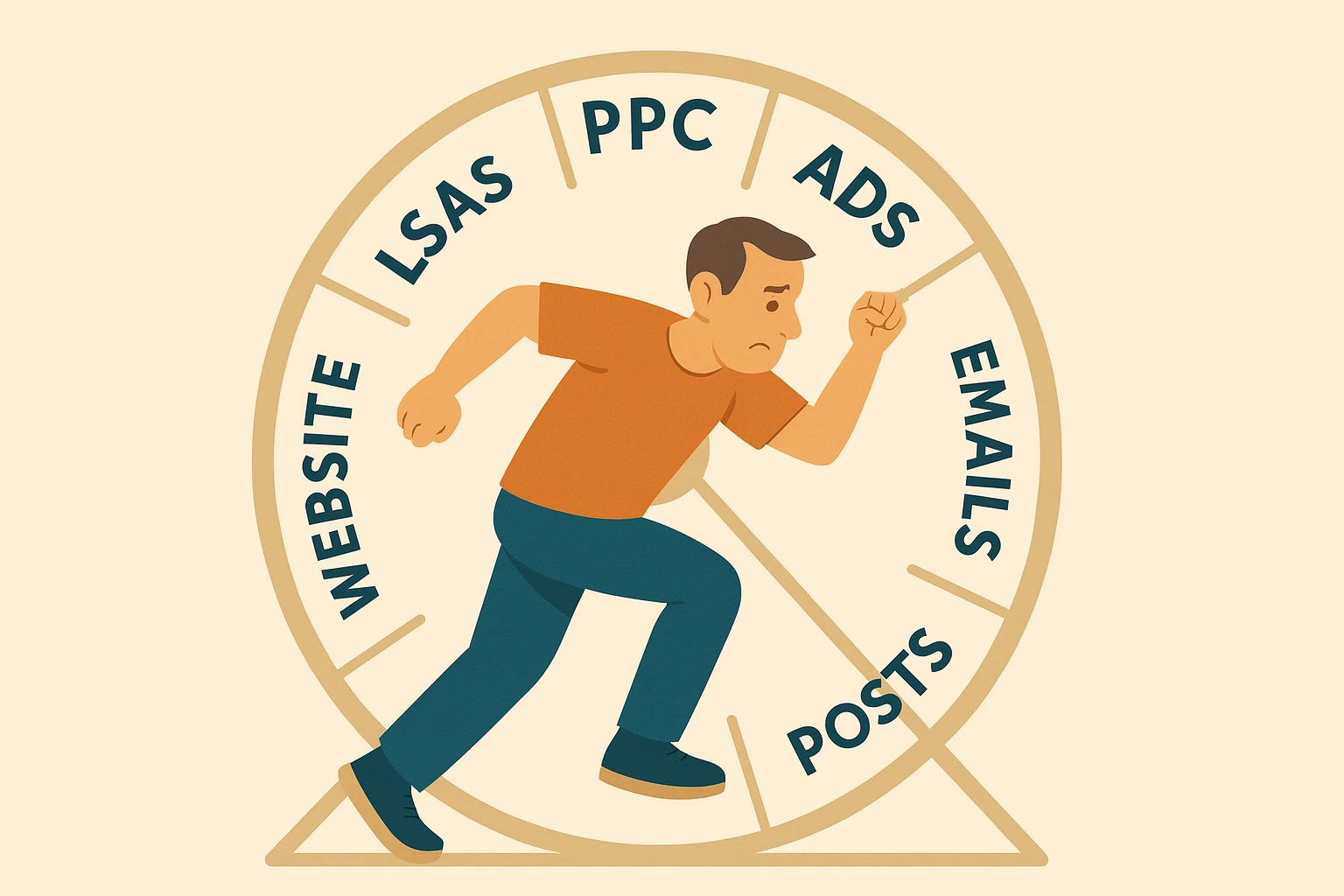
Marketing Tactics TrapYou’ve hired multiple marketing agencies over the years. Each one promised “more leads,” “better SEO,” and “game-changing campaigns.” Yet you’re still competing on price, still juggling new tactics every quarter, and still wondering why your marketing budget feels like it disappears without producing meaningful growth.

Sound familiar?

After 18 years in the trades industry and conversations with hundreds of frustrated contractors, I’ve learned this truth: most agencies keep home service companies trapped in the wrong game entirely.

The Execution Trap That’s Killing Your Growth

Your agency probably sounds like this: “We’ll get you 50 more leads this month! We’ll post three times a week! We’ll redesign your website with stronger CTAs!

They’re not wrong about the tactics. They’re just answering the wrong question.

This is the Execution Trap—the cycle where busy activity is mistaken for meaningful progress. Agencies keep you so focused on campaigns, impressions, and lead counts that you never stop to ask the question that actually moves the needle:

Are we positioned to win? Or just positioned to chase?”

Here’s what the Execution Trap looks like in the real world:

  • Agency sells a new channel or campaign
  • You approve more budget
  • Leads go up (temporarily), close rates don’t
  • You still can’t raise prices or escape price competition

Busy, but not better. Motion, but not progress.

The Three Pillars Most Agencies Ignore

While agencies obsess over clicks, impressions, and monthly lead reports, they miss the strategic fundamentals that actually drive profitable, sustainable growth.

1. Market Position Before Market Presence

Your agency wants to make you visible. But visibility without positioning is just expensive noise. If you’re not clearly differentiated—meaning prospects instantly know why you’re worth more—then the more visible you become, the more you blend in.

Weak positioning: “Fast, friendly, and fair pricing.”
Strong positioning: “The areas premium boiler and hydronic heating specialists for older homes.”

I’ve seen contractors raise prices by 20–40% while improving their close rates. They didn’t do it with more leads—they did it through stronger positioning. When you own a specific place in the customer’s mind, price becomes a secondary decision.

Ask yourself: If a premium customer compared you to three competitors for 30 seconds, could they instantly identify why you cost more?

2. Systems Before Campaigns

Quick question: What percentage of your marketing budget goes to management fees versus actual media spend? If you don’t know, that’s by design.

The industry standard is 15–25% management fees and 75–85% media spend. But without proper systems, you’re flying blind. Before you run another campaign, you need:

  • A clear separation of management fees vs ad spend
  • Campaign-level call tracking tied to revenue
  • Conversion tracking that includes booked jobs, not just leads
  • Customer lifetime value and revenue-per-channel calculations

If your agency can’t show revenue per channel in under 10 minutes, they’re guessing.

3. Revenue Optimization Over Lead Generation

Lead generation companies profit when you stay addicted to new leads. But your existing customer database is worth 5–10x more than cold traffic—and it’s the fastest path to profitable growth.

Integrated multichannel strategies outperform single-channel campaigns by 63%. Yet many agencies push new channels instead of optimizing what’s already working.

Examples of revenue optimization your agency probably isn’t doing:

Your biggest opportunity isn’t more leads, it’s more value per customer.

The 7–10% Rule Nobody Talks About

Top-performing home service companies invest 7–10% of gross revenue into marketing. But here’s the part agencies leave out: the allocation determines your results—not the amount.

Benchmark allocation looks like:

  • 40–60% digital channels (Google Ads, LSAs, SEO)
  • 15–25% traditional channels (direct mail, outdoor, door hangers)
  • 10–20% partnerships and local sponsorships

For a $4M company, that’s a $280K–$400K investment. Misallocating even 20% is a $56K–$80K mistake, and most agencies misallocate far more than that.

Agencies push what they know how to execute. Not what’s strategically best for your market.

Why Phone Calls Still Win (And Why Agencies Avoid Them)

Digital agencies love form fills and chats because they’re easy to track. But phone calls are still the highest-converting lead source in home services. They’re urgent, high-intent, and ready to buy.

Yet many agencies either ignore call tracking or bolt it on as an afterthought, because phone calls reveal the real quality of their leads.

The Strategic Shift That Changes Everything

Stop asking, “How can we get more leads?” and start asking:

“How can we command premium prices while improving our close rate?”

Stop measuring activity. Start measuring:

  • Revenue per customer
  • Close rates at premium pricing
  • Customer lifetime value
  • Market share inside your premium segment

Stop hiring vendors who execute tactics. Start working with strategic partners who help build the marketing foundation your company needs to scale.

The Uncomfortable Truth About Your Current Agency

Your agency isn’t necessarily incompetent, they’re just incentivized to keep you tactical. If you suddenly started focusing on positioning, pricing power, and systems, you might need less of what they sell.

And that’s not good for their retention rate.

A Quick Example: How Strategy Beats Tactics

A $6M HVAC company we worked with was stuck at 12% net profit despite strong lead volume. They’d tried several different agencies in four years.

Once we repositioned them as the area’s premium heat-pump and energy-efficient system specialists, and rebuilt their budget allocation, they:

  • Raised prices 25%
  • Improved close rates
  • Reduced marketing channels from 7 to 4
  • Grew revenue by $1.8M without increasing lead volume

Not because of more leads. Because of better strategy.

How to Audit Your Agency in 10 Minutes

Ask your agency these questions:

  • What makes us worthy of premium pricing, and how does our marketing reflect that?
  • Can you show media spend vs management fees for every channel?
  • Do you track booked jobs and revenue by campaign?
  • How do you optimize our existing customer base?
  • What systems have you built to improve close rates and pricing power?
  • What’s our actual revenue per channel, not just leads?

If they struggle with these, you don’t have a strategic partner, you have a vendor.

What Actually Works

The path forward is simple, but it requires a different way of thinking:

  1. Audit your marketing foundation. Positioning, pricing, segmentation, budget allocation, tracking systems.
  2. Identify what truly differentiates you. Not what you like about your business, what premium customers value enough to pay more for.
  3. Build your brand around that difference. This is about perception and category ownership, not logos.
  4. Target premium buyers intentionally. The companies who thrive are the ones who stop trying to serve everyone.
  5. Measure what matters. Revenue per customer, close rates at premium prices, lifetime value, and share of wallet.

The Choice Is Yours

You can keep chasing leads, switching agencies, lowering prices, and hoping next quarter feels better. That’s the Execution Trap.

Or you can make the strategic shift that top HVAC, plumbing, and electrical companies use to dominate their markets:

Positioning over visibility.
Systems over campaigns.
Revenue optimization over lead generation.
Strategy over tactics.

Your next marketing decision will either perpetuate the cycle, or break it.

Ready to Break the Execution Trap?

If you’re a home service company tired of competing on price and ready to build a marketing system that actually scales, the next step is simple: audit your foundation.

Book a Strategy Call

Why Most Home Service Marketing Agencies Get It Wrong Read More »
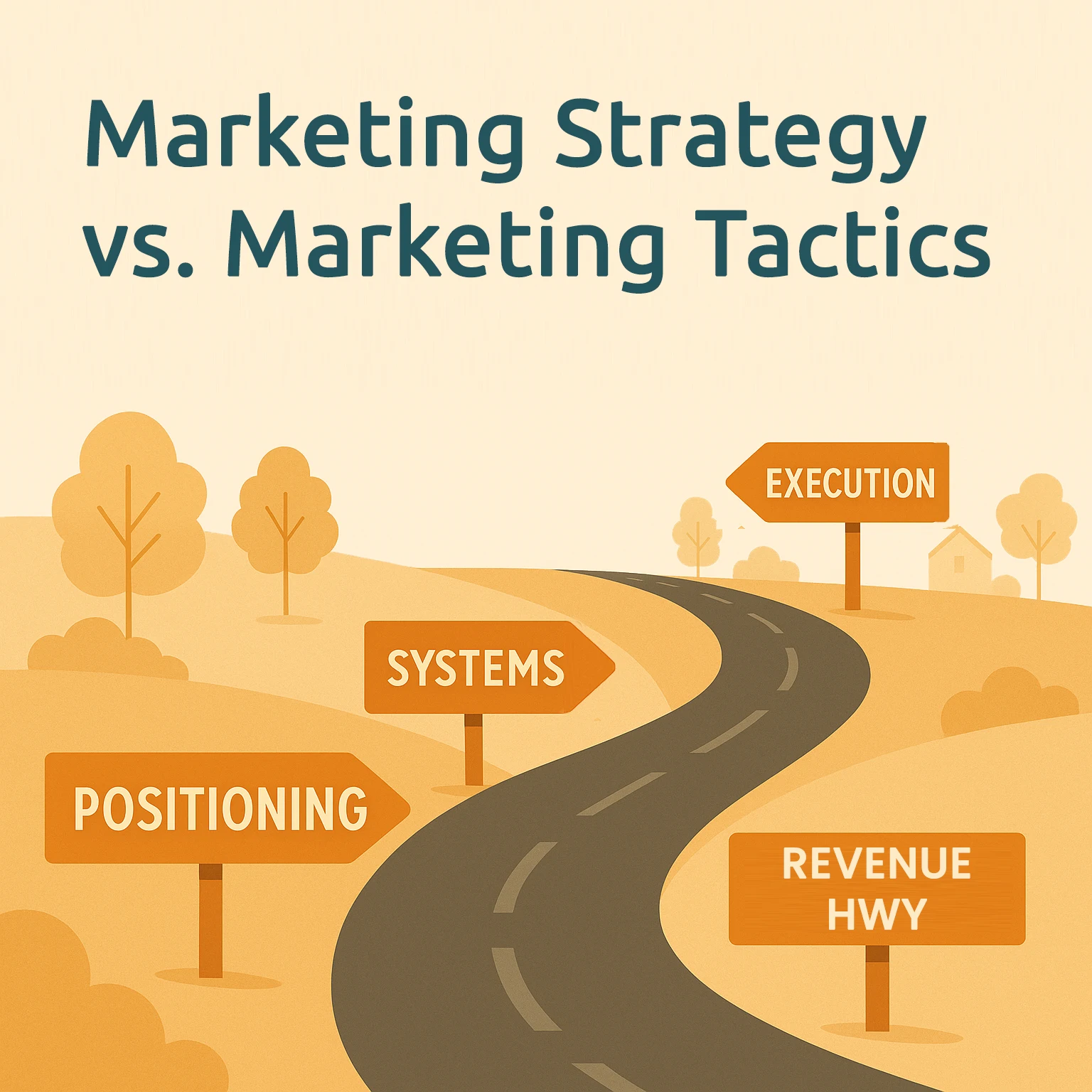
Marketing Strategy vs. Marketing Tactics

Marketing Strategy vs. Marketing Tactics

From Tactics To Strategy

Why Most Home Service Companies Are Stuck in Execution Mode

What separates the HVAC or plumbing company doing $5 million a year from the one doing $50 million in the same market? Here’s a hint:

It’s not the number of Google Ads they run. It’s not their posting schedule. And it’s definitely not the shiny new marketing automation tool they bought last month.

The real difference is simple: one company has a strategy. The other has tactics.

In this guide, we’ll break down why so many home service companies stay stuck in execution mode, and how a strategic marketing foundation drives consistent, predictable, profitable growth.

1. The Execution Trap That Keeps Companies Stuck

Walk into any home service company’s marketing meeting and you’ll hear versions of the same conversation:

“We need more leads.”
“Can we increase our Google Ads budget?”
“What about LSA?”
“Should we try direct mail?”

This is the sound of a company stuck in execution mode, running from one tactic to the next without ever clarifying the bigger picture.

After 18 years in marketing for the trades, I see this constantly: companies spending $30K–$50K per month with no target customer profile, no pricing strategy, no positioning, and no measurable system for what actually drives profitable revenue.

They’re not running a marketing operation.
They’re running an expensive experiment.

2. Strategy vs. Tactics: The Million-Dollar Difference

Here’s a simple, real-world comparison:

Tactic: “We’re sending 10,000 direct mail pieces this month.”

Strategy: “We’re positioning ourselves as the premium provider for homeowners 55+ in the northwest suburbs; people who value reliability over price. Direct mail is our lead-in channel because this audience responds 3x better to physical mail than digital ads.”

See the difference? Tactics are what you do. Strategy is why you do it, who it’s for, and how it fits into your broader revenue architecture.

Without strategy, tactics become noise… expensive, time-consuming noise.

3. The Three Pillars of Strategic Marketing (That Most Companies Ignore)

1. Market Position Before Market Presence

Before you spend a dollar on advertising, answer:

  • Who exactly is our ideal customer? (Not “homeowners.”)
  • What problem do we solve better than anyone else?
  • Why should customers pay our premium price?

If you can’t answer these clearly, your marketing will default to price competition,  the death spiral of home services.

2. Systems Before Campaigns

A campaign delivers leads for a month. A system delivers revenue for years.

Strategic companies build:

Tactical companies chase the next “silver bullet.” Strategic companies build engines.

3. Metrics That Actually Matter

Which matters more?

A) 500 leads
B) $47 cost per acquisition, 2.3x return on ad spend, and 67% of revenue from existing customers

If you chose A, your mindset is tactical.

Lead count doesn’t matter. Profitability does.

4. Why Lead Generation Vendors Keep You Tactical

It’s not that vendors are bad. They just get paid to execute tactics, not design strategy.

  • PPC agencies want to run your Google Ads
  • Social companies want to post on Facebook
  • Direct mail houses want to print postcards

No one is asking: “Does any of this align with your positioning, pricing goals, and target customer?”

This is why companies end up with five vendors, mixed messages, and marketing costs that balloon to 12–15% of revenue.

Strategy-first companies stay in the optimal 7–10% range because their dollars work harder.

5. The Strategic Shift: From Vendor Collection to Revenue Architecture

Imagine your marketing engine looking like this:

  • Budget allocation is intentional—40–60% digital, 15–25% traditional, 10–20% partnerships based on documented performance.
  • Your premium positioning supports 20–40% higher prices while improving close rates.
  • Your channels reinforce each other—trucks, mailers, reviews, ads, and sales scripts all say the same thing.
  • You measure profitability, not lead count.

This is not fantasy. This is what happens when you move from tactical execution to strategic revenue architecture.

6. The First Step Out of Execution Mode

If you recognize your company in this article, here’s your starting point:

Pause all new marketing initiatives for two weeks.

Instead, answer these five questions with real data:

  1. Who are our most profitable customers?
  2. What’s our true cost per acquisition across all channels?
  3. What percentage of revenue comes from existing customers?
  4. What’s our average customer lifetime value?
  5. Why do customers choose us over cheaper options?

If you don’t know these, you’re not ready for more tactics. You need strategy.

7. The Strategy-First Model

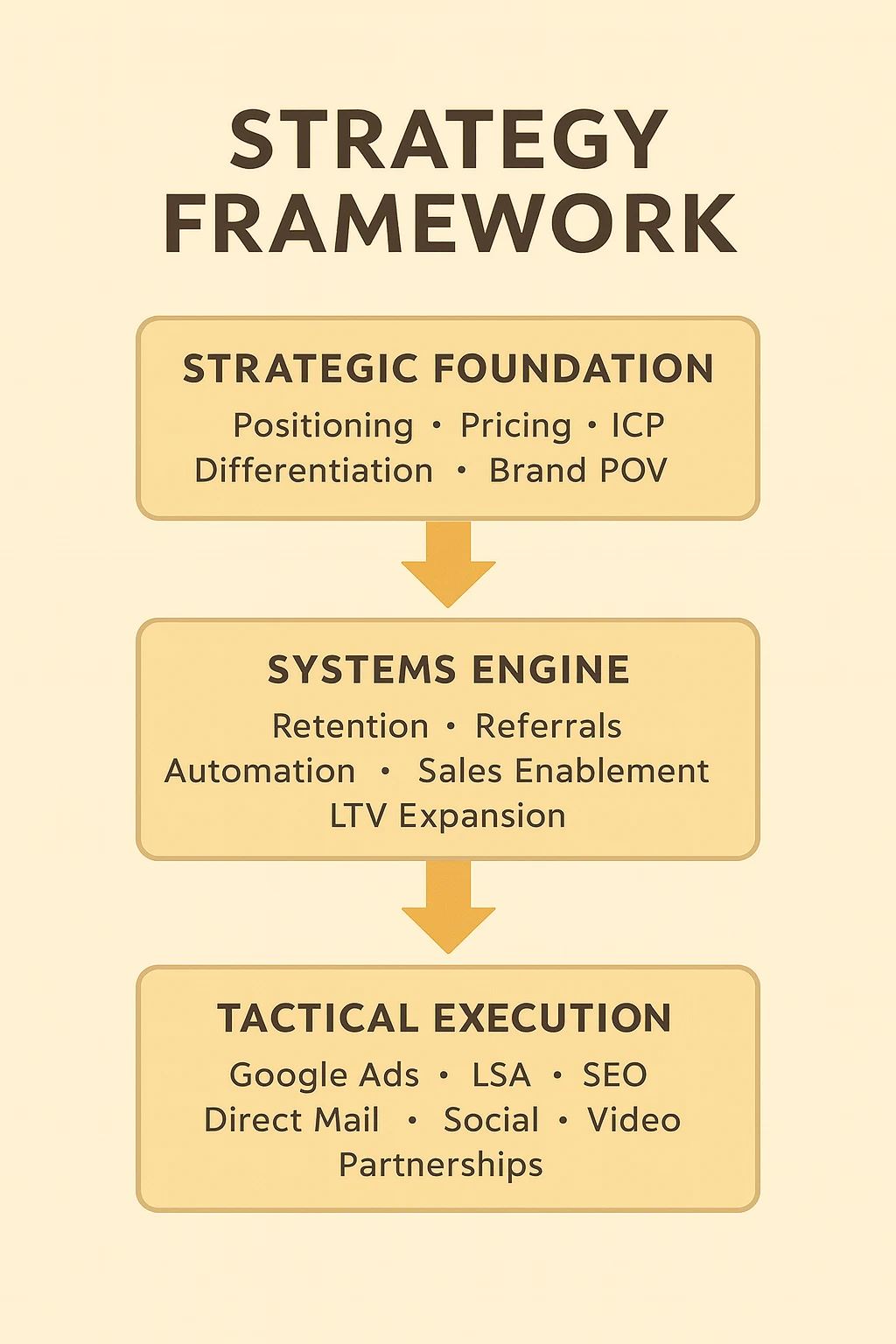
Strategy Framework
This is the model the $50M companies follow—intentionally or not.

Strategy drives systems. Systems drive tactics. Tactics execute the strategy.

Most companies skip the top two layers and wonder why growth stalls.

8. Ready to Build a Strategy That Scales?

Most HVAC, plumbing, and electrical companies will spend the next decade jumping from tactic to tactic, hoping something finally “works.”

A select few will step back, build a strategic foundation, and dominate their markets with predictable, profitable growth.

If you’re ready to stop competing on price and start commanding it, let’s talk.

Service Labs Group works exclusively with established home service companies ($2M–$10M) ready to build a premium, strategy-first marketing engine.

→ Book a Strategy Audit Call

→ Explore the Marketing Budget (7–10%) Framework

→ Learn How Premium Positioning Increases Prices 20–40%

Your competitors are playing checkers.
It’s time to start playing chess.

Marketing Strategy vs. Marketing Tactics Read More »

HVAC and Plumbing Marketing Budgets

The 7–10% Rule

How Much Should Your HVAC, Plumbing, or Electrical Company Spend on Marketing?

How Much Should Your HVAC, Plumbing, or Electrical Company Spend on Marketing?
Last month, an HVAC contractor called us in a panic. He’d just spent $47,000 on a marketing campaign that generated exactly three leads. When we asked what percentage of his revenue that represented, he went silent. He had no idea.

This isn’t uncommon. Most home service business owners approach marketing budgets with either blind faith or paralyzing hesitation. They’ll invest six figures in a new truck without blinking, but freeze when allocating marketing dollars, often because they have no benchmark to guide their decisions.

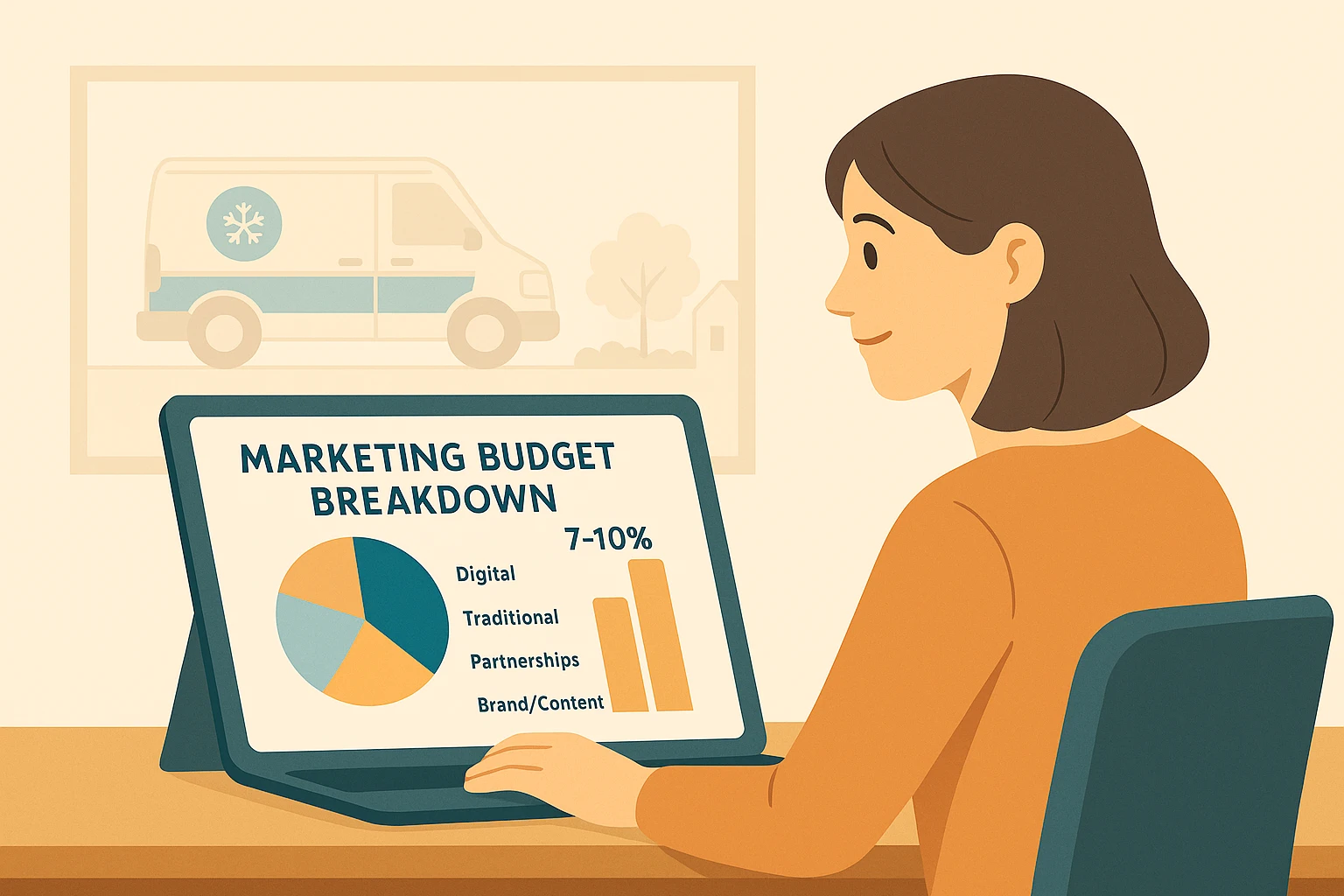
After analyzing dozens of successful HVAC, plumbing, and electrical companies, we’ve found that the top performers follow a surprisingly consistent pattern: they invest 7–10% of their gross revenue into marketing. But the percentage is only the beginning. What matters more is how they spend it.

Why the 7–10% Rule Works

The 7–10% benchmark isn’t pulled from thin air, it’s the equilibrium point where home service companies can sustain growth without sacrificing profitability. Here’s how spending levels typically play out:

Below 5%: You’re relying almost entirely on referrals. This works until it doesn’t. Companies in this range often experience feast-or-famine cycles and rarely scale beyond $2–3M.

5–7%: Maintenance mode. You maintain visibility but won’t aggressively grow market share—fine for stable markets, but not for competitive ones.

7–10%: The growth zone. Companies investing at this level build dependable lead flow and usually see 15–30% year-over-year growth when the budget is allocated strategically.

Above 12%: Common for new market launches, aggressive expansion, or companies rebuilding reputation. Effective but not always sustainable long-term.

Real Marketing Budget Examples for $1M, $3M, and $5M Contractors

Here’s what the 7–10% rule looks like at different revenue levels:

$1M Annual Revenue: $70,000–$100,000 annually ($5,800–$8,300/month)

$3M Annual Revenue: $210,000–$300,000 annually ($17,500–$25,000/month)

$5M Annual Revenue: $350,000–$500,000 annually ($29,000–$42,000/month)

To make this more concrete: if you’re a $3M contractor spending $20,000/month and generating 50 qualified leads with a 40% close rate, that’s 20 new jobs. With an $8,500 average ticket, that’s $170,000 in revenue—an 8.5X return.

The Optimal HVAC/Plumbing/Electrical Marketing Budget Breakdown

The companies getting the best results don’t just spend more—they allocate smarter:

40–60% Digital Marketing:
Google Local Service Ads, Search Ads, SEO, social ads, review management.
Digital captures high-intent customers at the exact moment they need service.

15–25% Traditional Marketing:
Direct mail, vehicle wraps, yard signs, and print.
A well-designed truck still delivers 30,000–70,000 impressions a month.

10–20% Partnerships & Community:
Real estate agents, property managers, sponsorships, referral programs.
These sources often close at 60–70%—your best possible leads.

10–15% Brand & Content:
Website development, video, photography, blog content, and conversion-focused copywriting.

Where Email Marketing Fits Into the Budget

Email marketing and automated follow-up sequences are one of the highest ROI channels for HVAC, plumbing, and electrical companies. Although the cost is low, the impact on revenue and retention is significant.

Email marketing fits within the Brand & Content portion of the budget and includes:

  • Unsold estimate follow-up automations
  • Membership renewal and service reminders
  • Seasonal tune-up campaigns
  • Slow-season revenue smoothing emails
  • After-service review requests
  • Re-engagement campaigns for dormant customers

Because email is an owned channel with minimal incremental cost, even small improvements in consistency dramatically increase customer lifetime value and help stabilize revenue year-round.

Media Spend vs. Total Marketing Investment

The 7–10% rule applies to your entire marketing ecosystem, not just ads.

Your total budget includes:

  • Media spend (ads, direct mail, sponsorships)
  • Marketing staff salaries or agency fees
  • Software and technology (CRM, call tracking, email platforms)
  • Content creation (photos, video, copywriting)
  • Website hosting and maintenance
  • Promotional materials

Ad Spend vs. All Other Marketing Costs

Many home service business owners misunderstand the difference between “ad spend” and “total marketing spend.” Paid media is only part of the picture.

Here’s a typical breakdown for HVAC, plumbing, and electrical companies:

Category % of Budget What It Includes
Paid Media (Ad Spend) 50–65% LSAs, PPC, Meta ads, direct mail postage/printing
Marketing Labor/Agency 20–30% In-house marketing staff, external agency fees
Tools & Technology 5–10% CRM, email platform, call tracking, scheduling tools
Content & Brand 10–15% Website, photos, videos, email marketing, blog content

Understanding these categories prevents the common scenario where a business believes they are investing $5,000/month—when in reality that is just their agency fee, with very little going toward paid media.

Adjusting Your Marketing Budget by Company Stage

New Companies (1–3 Years):
Budget 10–15% to build awareness fast.

Mature Companies (10+ Years):
Can hold at 6–8% thanks to established brand equity.

Expansion Mode:
Entering a new service area requires 12–15% until recognition catches up.

Premium Positioning:
If you charge 20–40% more, you must invest 9–12% to support the premium brand image.

How to Evaluate Marketing ROI

Before you scale spending, ensure these fundamentals are healthy:

Close Rate: At least 30–40% on qualified estimates.

Unit Economics: Average job value should be 3X your acquisition cost.

Operational Capacity: Can you handle 20–30% more volume?

The Most Common Marketing Budget Mistakes

Mistake 1: Only Spending “What Feels Comfortable”
A $2M contractor spending $1,000/month is investing 0.6%, that’s not enough to grow.

Mistake 2: Cutting Marketing During Slow Periods
This delays recovery and hands market share to competitors.

Mistake 3: Relying on a Single Channel
Local Service Ads and Google Ads alone, or direct mail alone, is fragile. Diversify.

Mistake 4: Not Tracking Results
Without tracking, optimization is impossible. Implement call tracking, ask customers how they found you, and review performance monthly.

How to Implement This in Your Business: Your 4-Week Action Plan

Week 1: Calculate Your True Current Spend
Include every marketing-related cost. This number is often surprising.

Week 2: Audit Your Allocation
Review how your current spend compares with industry benchmarks.

Week 3: Set Your Target Budget
Base it on revenue and growth goals, not guesswork.

Week 4: Rebalance and Test
Shift gradually toward a balanced mix. Give channels 90 days to prove performance.

The Bottom Line: Marketing Is a Growth Engine

The difference between companies that stall and companies that scale isn’t the quality of their work, it’s their willingness to invest consistently and strategically in marketing.

When you spend 7–10% of revenue, allocate it intelligently, and track it rigorously, marketing becomes your most predictable driver of growth.

Your next step: pull last year’s financials, calculate your true marketing percentage, and see where you stand. The number will tell you exactly what your growth potential looks like.

Frequently Asked Questions

Most growth-focused companies spend 7–10% of gross revenue.
Yes. Total marketing investment includes staff, tools, and content—not just ads.
Email marketing is part of your content and brand investment. It delivers extremely high ROI and supports follow-ups, retention, and seasonal demand smoothing.
Top performers spend 40–60% digital, 15–25% traditional, and the rest on partnerships and brand.
If your close rates and unit economics are healthy, 7–10% is rarely “overspending.”

Want help building a data-backed marketing budget for your home service company? Get in touch and we’ll create a customized plan.

The 7–10% Rule Read More »

Premium Marketing Strategy

How to Position Your Company as the Premium Choice

Premium Marketing Strategy

Premium Service Marketing Strategy

In competitive markets, being “affordable” isn’t enough. The companies that thrive are the ones that position themselves as the premium choice, winning higher-margin jobs without competing on price.

Here’s a scenario that plays out every day: your sales team presents a proposal. The prospect says, “Your price is higher than the other quotes I got.” Your rep scrambles to justify the difference, talks about quality and experience, maybe offers a discount. The deal either drags on or goes to the cheaper competitor.

Now imagine this instead: the prospect already knows you’re the premium option before they even call. They expect to pay more. When they hear your price, they nod and ask, “What’s the timeline to get started?” The difference isn’t what you say during the sales conversation, it’s what you’ve already built before it begins.

This is the power of premium positioning. It’s not marketing fluff; it’s a strategic framework that makes selling easier from first contact to final signature.

Why Premium Positioning Helps You Sell More (and Faster)

Many business owners fear that positioning themselves as premium will shrink their market. They worry about “pricing themselves out.” The opposite is true when you do it right.

Price objections decrease. When prospects already see you as the premium option, they’re mentally prepared for higher pricing. The conversation shifts from “why so expensive?” to “is this the right solution for me?”

Sales cycles shorten. Budget shoppers self-select out early. Qualified buyers move faster. Studies show companies with clear premium positioning close deals up to 50% faster than competitors without it.

Conversion rates improve. Clarity beats volume. When your message is focused and specific, the right customers resonate and convert at higher rates than when you try to appeal to everyone.

Your sales team gains confidence. A clear, proven value story replaces price apologies. Your team can own the conversation rather than defend it.

3 Steps to Build a Premium Brand That Justifies Higher Prices

1. Identify Your Differentiating Value

“We provide quality service” isn’t differentiation. Everyone says that. Your differentiating value must be:

  • Specific: Instead of “fast service,” say “guaranteed same-day response with a two-hour arrival window.”
  • Provable: Back up claims with data, certifications, warranties, or guarantees.
  • Valuable to your target customer: Differentiate on what matters to them, not to you. A homeowner might care more about warranty length or communication than the origin of your parts.
Pro Tip: Ask, “What do we do that competitors can’t or won’t?” The answer often reveals your real edge.

2. Build Your Brand Around That Difference

Once you know what makes you different, every marketing touchpoint should reinforce it. This is where brand marketing becomes a sales tool.

  • Your website should show, not tell. Use before-and-after photos, process visuals, and guarantees that support your positioning.
  • Your Google Business Profile reviews should highlight specifics (“They used thermal imaging to find a leak other plumbers missed”).
  • Your sales materials should make price comparison irrelevant by proving why your process or results are unique.

Even your hold music, email signature, and proposal templates should align with your premium brand. Every detail builds the perception that “these people are different.”

3. Target and Message to Premium Buyers

Not everyone is your customer. Premium positioning means focusing on the right ones.

  • Geographic targeting: Focus ad spend on neighborhoods where premium buyers live. A $5,000 HVAC replacement means different things in different zip codes.
  • Message matching: Use ad copy that pre-qualifies. Instead of “HVAC repair, call now,” say “Premium HVAC solutions for homeowners who value comfort and reliability.”
  • Expert content: Premium buyers research before buying. Publish in-depth articles, case studies, and FAQs that show expertise and justify your value.

How to Respond to Price Objections with Confidence

Even with great positioning, prospects may question price. The conversation changes depending on your positioning.

Before:
“Your price is too high.”
“We use quality materials and experienced technicians…”
“The other guy said the same thing and he’s $2,000 less.”

After:
“Your price is higher than I expected.”
“That’s right. We’re typically 20–30% higher than basic providers because we include [specific differentiator]. The question isn’t whether we’re cheapest, it’s whether you want [outcome your difference provides]. If price is the top concern, we can recommend other good companies who may be a better fit.”

This approach reinforces your positioning rather than defending it. It gives the prospect permission to choose differently, which often increases respect and conversion.

Real-World Example: How One HVAC Company Used Positioning to Increase Close Rates

Company A markets itself as “honest, reliable, affordable.” They compete on price, offer frequent discounts, and emphasize longevity. Their average job value is $6,500, and they close about 40% of estimates.

Company B brands itself as “The Indoor Air Quality Specialists.” Every message focuses on health, comfort, and advanced diagnostics. They show thermal imaging reports, air quality test results, and explain their assessment process. Their average job is $8,500, and they close 58% of estimates.

Company B isn’t necessarily better at HVAC installation. They’re positioned better. They’ve built a story that matters to health-conscious homeowners, and their sales team confidently reinforces it.

Step-by-Step Premium Positioning Plan (12-Week Guide)

Weeks 1–2: Define Your Differentiation

  • Survey your best customers; why did they choose you?
  • Interview your sales team; what makes deals easy or hard?
  • Audit competitors; what do they all claim? Say something different.
  • List 3–5 specific, provable, valuable differentiators.

Weeks 3–4: Align Your Messaging

  • Rewrite your website homepage around your key differentiator.
  • Update your Google Business Profile description.
  • Create ad copy that pre-qualifies premium buyers.
  • Develop sales scripts that confidently explain your value.

Weeks 5–8: Build Supporting Evidence

  • Gather case studies and testimonials mentioning your differentiator.
  • Create videos or photo stories showing your process and results.
  • Add guarantee or warranty language that reinforces your positioning.

Weeks 9–12: Train Your Team

  • Role-play price objection responses.
  • Practice explaining your difference in 30 seconds or less.
  • Design proposal templates that highlight premium value.
  • Establish when to walk away from price-only prospects.

The Bottom Line

Premium positioning isn’t about charging more for the same thing. It’s about clearly communicating genuine value to the customers who care most. It makes it easy for the right people to choose you and for the wrong ones to self-select out.

When done well, premium positioning transforms your business from “one of several options” into “the obvious choice.” It raises margins, improves close rates, and builds a sustainable brand that doesn’t rely on discounting.

The question isn’t whether you can afford to position as premium. It’s whether you can afford not to.


Ready to reposition your brand as the premium choice?
Let’s talk about a strategy that fits your market and team. Schedule a consultation.

How to Position Your Company as the Premium Choice Read More »

Turn Unsold Estimates Into Closed Deals

Turn Unsold Estimates Into Closed Deals

Turn Unsold Estimates Into Closed Deals

Most Companies Stop Too Soon, Here’s Why That’s Costing You Thousands

If you’re like most home services business owners, you’re sitting on a goldmine you don’t even know you have. Hidden in your CRM or filing cabinet are hundreds—maybe thousands—of unsold estimates representing hundreds of thousands of dollars in potential revenue.

The hard part is already done. You’ve generated the lead, scheduled the appointment, sent a qualified technician, diagnosed the problem, and presented a solution. The homeowner just said “let me think about it” or “we need to get another quote.”

And then… crickets.

Here’s the reality: According to industry research, 60% of sales are made after the fourth follow-up contact*. Yet most home services companies give up after one or two attempts. That means you’re leaving a fortune on the table simply because you lack a systematic follow-up process.

Let’s fix that. Here’s how to create a follow-up system that turns cold estimates into closed deals without being pushy or annoying.

In this guide, you’ll learn:

  • Why most follow-ups fail (and how to fix them)
  • The exact 5-stage system top companies use to close more estimates
  • How to automate the process using your existing CRM tools

Why Most Follow-Up Attempts Fail

Before we dive into what works, let’s talk about why most follow-up efforts fall flat:

Inconsistency: Your technician follows up with some customers but not others. There’s no system, so it depends entirely on who remembers and who has time.

Wrong timing: You call once the next day, and when they don’t answer, you assume they went with someone else.

Wrong message: Your follow-up sounds like “So, are you ready to buy yet?” instead of providing additional value or addressing concerns.

Single channel: You only call, or only email, missing opportunities to connect through the channels your customers actually prefer.

A proper follow-up system addresses all of these issues with automation, multiple touchpoints, varied messaging, and multi-channel outreach.

Pro Tip: The goal of every follow-up isn’t to close the sale, it’s to move the conversation one step closer to yes.

The Anatomy of a High-Converting Follow-Up System

Stage 1: The Immediate Follow-Up (Same Day)

Your follow-up sequence should begin before your technician even leaves the home. Before departing, your tech should:

Send a text message with a link to the written estimate and a personal note: “Thanks for your time today, [Name]. Here’s your estimate for the [system/repair]. I’ll check in tomorrow to answer any questions. – [Tech Name]”

This accomplishes three things: It confirms you have the right contact information, it puts the estimate in their hands immediately, and it sets expectations for future contact.

Stage 2: The Value-Add Follow-Up (24-48 Hours)

This is where most companies make their first and only attempt. Don’t waste it with “Just checking in!” Instead, provide genuine value:

Phone call (Day 1): Your technician or a dedicated follow-up specialist calls with a specific reason. “Hi [Name], I wanted to reach out because I forgot to mention that we have 0% financing available for 12 months on your AC replacement. I know the investment was a concern, and this could bring your monthly payment down to around $150. Do you have a minute to discuss?”

Email (Day 2): Send an automated email with helpful content related to their specific issue. For an AC replacement estimate, this could include “5 Warning Signs Your AC is About to Fail” or “How to Know if Repair or Replacement is Right for You.” Include a soft call-to-action and make it easy to book.

The key is that you’re being helpful, not pushy. You’re the expert guide, not the desperate salesperson.

Stage 3: The Objection-Handler Follow-Up (Days 3-7)

Now you’re entering the zone where most companies have given up entirely. That’s your competitive advantage.

Text message (Day 3): “Hi [Name], I know you’re probably getting multiple quotes. When you’re ready to compare, I’m happy to review the details of what we proposed and answer any questions. No pressure—just want to make sure you have all the info you need to make the best decision.”

Email (Day 5): Send an automated email addressing the most common objections for your service. Use subject lines like “How we compare to other HVAC companies” or “What’s actually included in our price.” Include customer testimonials from people who were initially price-shopping but chose you for quality.

Video message (Day 7): If you have the contact’s email, send a quick personalized video (use Loom or similar) where your technician or sales manager recaps the estimate and offers to answer questions. This personal touch stands out dramatically in a sea of generic follow-ups.

Stage 4: The Long-Game Follow-Up (Weeks 2-8)

At this point, the homeowner has either hired someone else, decided not to do the work right now, or is still dragging their feet. Your job is to stay top-of-mind without being annoying:

Week 2: Email with seasonal relevance. “With temperatures expected to hit 95 next week, I wanted to follow up on your AC estimate. Our schedule is filling up fast—I can still get you in this week if you’d like to move forward before the heat wave hits.”

Week 4: Educational content. Add them to your monthly newsletter or send a one-off email with genuinely useful information about home maintenance, energy savings, or DIY tips (nothing that would replace your service, of course).

Week 6-8: The “final” follow-up. “Hi [Name],  I wanted to reach out one last time about your [service] estimate. If now’s not the right time, I totally understand. But if you decide to move forward in the future, we’d love to earn your business. Feel free to reach out anytime.”

Ironically, this “I’ll leave you alone” message often triggers a response because it removes pressure and gives the homeowner back control.

Stage 5: The Retargeting Campaign (Ongoing)

Even after your direct follow-up sequence ends, your marketing should keep working:

Facebook and Instagram ads: Use your CRM data to create a custom audience of unsold estimates and show them targeted ads highlighting your financing options, limited-time promotions, customer reviews, or seasonal messaging.

Google Display retargeting: When these homeowners browse other websites, your ads appear reminding them of your company and offer.

Seasonal reactivation campaigns: When the seasons change (approaching summer for AC, approaching winter for heating), send a targeted email or direct mail piece to old estimates letting them know you’re still available and reminding them of the importance of the work.

Stage 6: Direct Mail for High-Value Estimates

While automation and digital follow-ups handle most opportunities efficiently, high-value estimates, like system replacements, repipes, or panel upgrades, deserve an extra personal touch.

That’s where direct mail shines. A well-timed postcard or letter can make your company stand out when the homeowner is comparing quotes or waiting to move forward.

Use your CRM to identify any unsold estimates above a certain threshold (for example, jobs over $4,000). Then send a short, professional mailer that:

  • Reiterates the value of your proposal

  • Highlights financing or warranty options

  • Includes a clear call-to-action (QR code or link to approve the estimate online)

Personalized mail, especially when it references the homeowner’s specific project, feels tangible, builds trust, and often gets noticed when inboxes are crowded.

Combine this with your digital retargeting for maximum effect: see your brand in the mailbox, inbox, and social feed—all reinforcing the same message.


The Technical Setup: Making It Actually Happen

A system is only valuable if it actually runs. Here’s how to implement this without adding hours to your day:

Use your CRM or service software: Platforms like ServiceTitan, Housecall Pro, Jobber, or even simpler tools like HubSpot have automation features. Set up automated email sequences triggered when an estimate is marked “pending” or “unsold.”

Create templates: Write your email templates, text message scripts, and phone call scripts once. Personalize with merge fields (customer name, service type, estimate amount, tech name) so they feel custom.

Assign responsibility: Decide who owns follow-up. Is it the technician who wrote the estimate? A dedicated inside sales person? Office manager? Be crystal clear about who’s doing what.

Track and measure: Create a simple dashboard showing how many estimates are in follow-up, how many touchpoints have been completed, and most importantly, how many are converting back to sales. This data will help you refine your approach.

If your CRM doesn’t have built-in automation, tools like n8n, Zapier, or HighLevel can trigger emails, texts, or postcards automatically when an estimate is marked unsold, ensuring every lead enters your follow-up funnel.

What to Say (and What Not to Say)

The language you use in follow-ups matters enormously. Here are some guidelines:

Do focus on value: Every touchpoint should offer information, education, or solutions to objections. “I wanted to share…” “I realized I didn’t mention…” “I thought you’d find this helpful…”

Don’t be vague: Avoid “just checking in” or “following up on your estimate.” Be specific about why you’re reaching out.

Do acknowledge reality: “I know you’re probably talking to other companies…” or “I understand this is a big investment…” shows empathy and builds trust.

Don’t create false urgency: If you don’t actually have a limited-time offer or scheduling constraint, don’t invent one. Homeowners see through it and it damages trust.

Do make it easy: Every message should include a simple way to respond—a phone number, text line, or booking link. Remove friction.

The Numbers: What to Expect

When implemented correctly, a systematic follow-up process typically converts 30-40% of previously cold estimates into closed deals. Let’s put that in perspective:

If you write 100 estimates per month with an average value of $5,000, and 40 of them go unsold initially, that’s $200,000 in lost revenue every month. If you convert just 30% of those through follow-up, you’re adding $60,000 in monthly revenue—$720,000 per year—from work you’ve already bid.

That’s not counting the referrals and repeat business these customers will generate over their lifetime.

Getting Started Tomorrow

You don’t need to build the perfect system before you start. Here’s how to begin immediately:

This week: Create a simple spreadsheet of all unsold estimates from the last 30 days. Pick up the phone and call five of them today with a specific value-add message. Track what happens.

This month: Write three email templates, one for day two, one for day five, and one for week two. Begin manually sending these to every new unsold estimate.

Next month: Set up automation in your CRM or email platform so these emails send automatically. Add text message touchpoints.

Quarter two: Implement retargeting ads and build out your long-term nurture sequences.

The fortune is truly in the follow-up. Your competitors are walking away after one or two attempts. Your customers need multiple touchpoints before they’re ready to buy. And your business deserves to capture the revenue from work you’ve already quoted.

Start following up systematically, and watch your close rate climb while your marketing costs stay exactly the same. That’s the definition of marketing supporting sales.

Want Help Setting Up Your Follow-Up System?

If you’d like expert help implementing automated follow-ups in ServiceTitan, Jobber, or another platform, our team can help you recover lost revenue from unsold estimates. Schedule a free consultation.


* Source: Science-Backed Tips for Making Better Sales Calls – HubSpot Blog

Turn Unsold Estimates Into Closed Deals Read More »

Wordpress Social Share Plugin powered by Ultimatelysocial
Scroll to Top